
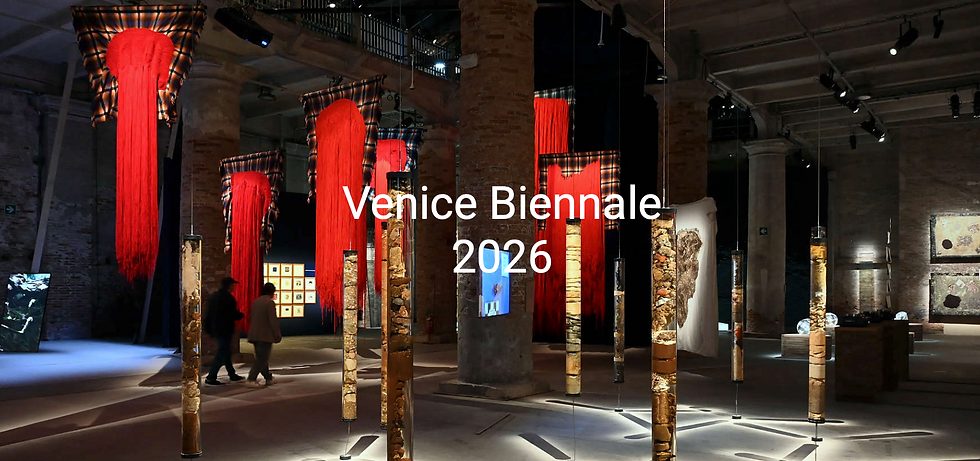
Venice Without Authority: Venice Biennale 2026
What is different about Venice Biennale 2026? Harmeet Singh takes stock of the mood at the 61st Venice Biennale
The mood in Venice this year is oddly nervous.
Not immediately, though. At first the familiar choreography still holds: collectors moving briskly through the Giardini with folded maps, assistants smoking behind national pavilions, journalists trying to compress entire countries into notebook fragments before the next vaporetto arrives. Yet after a few hours, the atmosphere begins to feel thinner than usual, as though the institutional confidence that normally structures the Venice Biennale has become procedural rather than convincing.
Conversations repeatedly drift toward the same subjects — the collapse of the awards structure, the resignation of the international jury, emergency funding disputes, the improvised public voting system introduced just before opening week. Normally these would remain peripheral administrative dramas. This year they sit directly inside the exhibition itself, shaping how viewers move through it and how the work is discussed.
The 61st Venice Biennale, curated under the title In Minor Keys, often feels less like a unified international exhibition than a large unstable argument about authority, spectatorship, and the difficulty of speaking collectively through contemporary art. What emerges across the Giardini and the Arsenale is not a dominant aesthetic tendency, but a shared condition of uncertainty. Monumental technological optimism has largely receded. In its place is a return to bodily scale, tactile material, and sensory immediacy — sometimes moving, sometimes exhausting, occasionally self-defeating.
That instability becomes especially visible in the Giardini, where several national pavilions abandon contemplative distance altogether and instead confront the viewer physically. The Austrian Pavilion, transformed by Florentina Holzinger into Seaworld Venice, has become one of the most discussed presentations of the Biennale, though not necessarily because people agree about it. Inside the flooded structure, performers navigate the space on jet skis beneath hanging church bells while carrying out punishing choreographed actions in varying states of undress. The smell of stagnant greywater hangs heavily in the air. At certain moments the pavilion feels less like performance art than an endurance chamber for both performers and spectators.
What makes the work compelling is not simply its extremity, but its refusal to stabilize into a clear metaphor. Climate anxiety, bodily vulnerability, spectacle culture, and institutional collapse all circulate through the space simultaneously without resolving into a single thesis. Some viewers leave exhilarated; others appear visibly irritated or fatigued. By the third day of previews, arguments outside the pavilion seemed almost as important as the work itself.
Germany approaches provocation very differently. Its pavilion, centered around the animatronic installation La Merde, relies heavily on engineered absurdity: mirrored interiors, speaking sculptures, repeated flatulence, exaggerated theatrical irony. At moments the work is genuinely funny. Yet over time the satire begins to flatten under its own self-awareness. The pavilion appears to understand the mechanisms of bourgeois spectacle culture while remaining comfortably protected inside them. Rather than implicating the viewer, it often performs critique as atmosphere.
Several pavilions this year also foreground scent in ways that shift attention away from visual interpretation entirely. In the Belarus Pavilion, the smell of damp soil and decaying flowers fills the space with the uneasy familiarity of a neglected cemetery after rain. Syria’s reconstruction of a damaged Palmyra tomb tower incorporates regional resins and spices that settle gradually into clothing and skin. These interventions are among the Biennale’s quieter successes. They avoid the rhetoric of immersion that dominates so much contemporary installation practice and instead operate almost incidentally, through accumulation and proximity.
Elsewhere, a very different rhythm emerges. Away from the confrontational density of the Giardini, several presentations in the Arsenale and surrounding exhibitions work through restraint, slowness, and material fragility. These are often the works that remain longest in memory afterward.
The return of the India Pavilion after a seven-year absence is among the strongest examples. Curated by Dr. Amin Jaffer under the title Geographies of Distance: Remembering Home, the exhibition avoids both technological spectacle and overt nationalist framing. Instead, it assembles a series of works concerned with migration, inheritance, ecological vulnerability, and domestic memory without forcing them into a singular political narrative.
Its emotional center is Sumakshi Singh’s Permanent Address. Using suspended hand-embroidered white thread, Singh reconstructs the outline of a Delhi home built by her refugee grandparents in the years following Partition and later demolished. Visitors move slowly through translucent architectural forms that appear simultaneously present and vanishing depending on where one stands. Nothing in the installation insists on monumentality. Its force comes through delicacy, repetition, and spatial hesitation.
What is striking is how long people remain inside it. In a Biennale environment shaped by constant circulation and accelerated viewing, visitors here tend to slow down almost involuntarily. Some sit quietly along the edges of the structure for extended periods. Others photograph details unsuccessfully, unable to fully capture the shifting density of thread against light. The work resists instant readability without becoming obscure.

Nearby, Alwar Balasubramaniam and Skarma Sonam Tashi ground the pavilion materially. Tashi’s mud-brick structures, produced from recycled school notebooks mixed with Ladakhi soil, establish a subtle dialogue between Himalayan ecological fragility and Venice’s own unstable lagoon environment. The comparison never feels forced. Likewise, Ranjani Shettar’s suspended beeswax forms and Asim Waqif’s bamboo installations avoid the polished sustainability rhetoric that often accompanies ecological art at international exhibitions. Their materials retain weight, texture, and labor.
The Japan Pavilion operates through a similarly intimate register. Ei Arakawa-Nash’s Grass Babies, Moon Babiesplaces reflective infant dolls throughout both the interior and surrounding gardens, encouraging visitors to physically lift and carry them. The gesture initially feels playful, almost slight. Over time, however, the repeated bodily interaction produces a more complicated emotional atmosphere around care, dependency, and collective responsibility. One begins noticing how differently people hold the figures — cautiously, awkwardly, affectionately, sometimes refusing to engage at all.
What becomes increasingly difficult to ignore across this Biennale is the weakness of the supposedly “safe” exhibitions. In earlier editions, neutrality could still masquerade as sophistication. Here it often reads as institutional anxiety.
The United States Pavilion exemplifies this problem. Following federal funding reductions, the presentation centers on Alma Allen’s smooth biomorphic sculptures in marble and bronze. The work is technically refined and materially expensive, but the installation struggles to establish urgency within the broader emotional climate of the Biennale. The abstract forms remain oddly insulated from both the historical architecture of the pavilion and the surrounding geopolitical atmosphere circulating through Venice this year.
That insulation may partly explain why so many visitors move through the exhibition quickly, often without returning. The pavilion is not unsuccessful in any obvious formal sense. If anything, it feels too resolved. In a Biennale dominated by fracture, exhaustion, and institutional doubt, aesthetic certainty starts to resemble distance.
The geopolitical tensions surrounding several national pavilions make this even more apparent. The Israeli and Russian Pavilions, heavily secured and surrounded at various moments by protest activity, operate less as conventional exhibitions than as contested territorial spaces. Visitors encounter military police, barricades, activist interventions, and surveillance before encountering art.
Inside the Israeli Pavilion, the minimalist installation Rose of Nothingness — a flower suspended inside a freezer — risks becoming overwhelmed by the conditions surrounding it. Whether that tension is productive or evasive depends largely on the viewer’s expectations. The Russian Pavilion, meanwhile, projects aggressive sound into adjacent walkways, extending its presence beyond architectural boundaries altogether. In both cases, the distinction between cultural presentation and state performance becomes difficult to maintain.
Still, despite its structural contradictions, the Biennale remains strangely compelling precisely because it cannot fully control these collisions. Very few international exhibitions gather so many conflicting political, aesthetic, and emotional positions into such close physical proximity. At times Venice resembles less a curated exhibition than a temporary diagnostic system for global instability.
This year, that instability became impossible to contain within traditional institutional hierarchies. Following the jury collapse, the emergency introduction of a visitor-based public voting system fundamentally altered how people discussed the exhibition. Conversations in queues shifted away from predicting professional awards toward arguing over personal resonance and emotional impact. Unofficial polling apps circulated constantly across phones and social feeds. Outside the India Pavilion, visitors debated whether Singh’s fragile thread architecture carried more lasting force than Holzinger’s overwhelming sensory assault in Austria.
The split felt larger than aesthetic preference alone. It exposed competing desires for what contemporary art should provide during periods of social exhaustion: confrontation, sanctuary, irony, collective experience, or simply silence.
Perhaps this unintended democratization will prove temporary. The Biennale remains deeply entangled with state power, private wealth, and institutional prestige regardless of how voting mechanisms are adjusted. Yet something undeniably shifted this year once the authority of the official jury disappeared. Without the familiar architecture of cultural validation, viewers appeared less certain, but also more attentive. People lingered longer inside difficult works. Others openly disagreed in ways that felt less performative than usual.
The strongest exhibitions seemed to understand this uncertainty instinctively. Rather than offering polished conclusions, they worked through incompleteness, fragility, and material pressure. They avoided explaining themselves too fully.
As evening settles over the Arsenale, the atmosphere outside the pavilions feels unusually unresolved. Visitors sit along the water scrolling through unofficial rankings that no longer carry institutional legitimacy. Others continue debating exhibitions whose meanings seem to shift depending on who is speaking. Nearby, exhausted invigilators begin closing doors for the night while conversations continue in fragments across the docks.
What remains after this Biennale is not consensus, but exposure — the realization that the systems historically responsible for assigning cultural authority no longer appear entirely stable, even to the institutions performing them. The most affecting works this year did not attempt to overcome that instability. They stayed inside it.
Venice has always mirrored the anxieties of its historical moment. This year, for perhaps the first time in decades, it also mirrored institutional doubt.

About the Author
Harmeet Singh is a medical doctor by qualification, a bureaucrat by profession, and now a filmmaker and practising artist of repute