
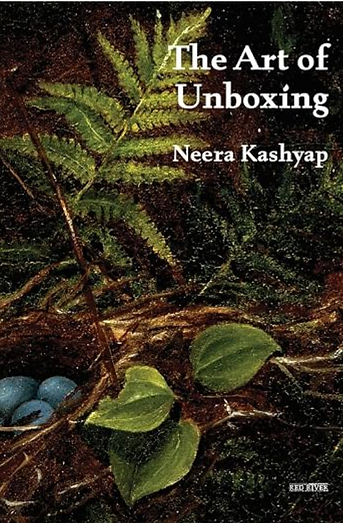
The Art of Unboxing
By Neena Kashyap
Red River Publications, 2026
Unfolding Life’s Hidden Layers
By Dr. Rakesh Chandra
“The Art of Unboxing” is a debut collection of poems written by Neera Kashyap over a period of time. It contains a beautiful bouquet of 87 poems and 10 prose poems. The book has been divided into twelve parts, each reflecting a distinct thought process.
These poems cover many perspectives, ranging from nature’s beauty to the humdrum affairs of daily life that we generally tend to ignore as subjects for writing. However, the most striking aspect of the book is the poetess's strong and unwavering affinity for Mother Nature, for whom her intense love remains undiluted. She carries this spirit to the city as well, where she often moves intermittently. Her poem “A Secret Shared” is a testimony to this fact. She feels the ‘force of nature’ and its ‘duality’ while living in the hills. She finds herself a witness to the ‘slopes of wildflowers’, a ‘blackbird gazing at the sky’, and the ‘springing up of a healing herb, an orange poppy rainbow.’ Similarly, she is a witness to a ‘robin hop across my lawn’, pigeons at the feeder, and a kite lying still on a treetop. The duality of nature in the hills and the cities is, in fact, an eyewash: the realm of nature is all-encompassing in its entrancing magic. In this context, who can deny the breathtaking charm of the rains? In her poem “Illusory Silver”, even occasional rains have been described beautifully, where the rains are accompanied by a koel's call, the presence of wet leaves glistening in the sun, the strident sounds emanating from the nest-building barbet's tuk tuk, a pigeon's flapping wings as it ‘sips rains’, and the spectacle of a puddle in the lawn mirroring the sky. In her nature poems, she has captured even the smallest moments, which come to her like drops of nectar. In the same poem, she has beautifully used the expression “tuk tuk” associated with a barbet, which adds beauty to the poem. The poem is embellished with other beautiful images of nature. However, the poetess has not confined herself to the pleasant side of nature. Her poetry also turns to the wildfire occurring in a jungle. In her poem “Gifts”, the poetess has captured the nuances of a forest fire by describing it as ‘a glowering snake slithering down a hill before dawn.’ She is quite adept at describing the various facets of nature through astonishing imagery. In her poem “Letting Go”, she terms the coconut tree's green pods as “bombshell babies.” For people living in the hills, the Himalayan peaks are a great attraction. The grand spectacle of Nanda Devi, one of the Himalayan peaks, is no exception. She has wonderfully described it using the striking image of a ‘cathedral’, which seems to be truly out-of-the-box thinking.
In her poem “Tree Woman”, she has unravelled the intricate and delicate relationship between a tree and a woman—a vivid, intense, and powerful portrayal of a bond that has existed since time immemorial.
Though the poetess mainly resides in the hills amidst nature, she is fully aware of the modern-day absurdities of city life. She has articulated the plight of a woman searching for a footing in the city after losing her home in the hills. She strongly feels that, in such cases, the aspiring city dweller needs to learn a new lingua franca and a new grammar to survive in a concrete jungle. In her poem “Reversals”, the poetess paints a grim picture of a tribal woman working as a maid in a city household. Being a sensitive human being, her anger and anguish explode through the lines of the poem. That is the unpalatable truth of our present system. But this is not the end of the sordid story. The condition of women in society has perhaps changed a little, but we still have miles to go in this regard. Her poem “Tall Dreams” explores the phenomenon of broken dreams, in which she expresses her wish to see women making all-round progress and breaking glass ceilings. Her wish could not be fulfilled even after the pandemic. What can be said of recognition in places of importance outside when she could not earn respect and honour on the home front? Her poem “Riots” is also an eye-opener and worth reading, as it raises a very important question. In the event of a riot outside our homes, will it help to contain our anger and remain indoors in order to quell the bloodshed and mayhem outside? It is not easy to answer, but for a reader, it is certainly food for thought.
Her poems remind us of the songs of wandering gypsies. Her nomadic forays into our world evoke mixed feelings of both joy and nostalgia. She says in “Her Poems”: “She wrote her poems for the winds / if you read the winds, you can read them.” In this picturesque collection, she has truly unboxed her inner thoughts, her enduring philosophy of life, and her deep reflections on various aspects of our existence on this earth. She has visited temples, dargahs, heritage sites, and other places of significance and written poems of exceptional quality. At times, she barely describes a scene; at others, she raises pertinent questions before her audience. She appears to be well conversant with the art of unboxing. Detailing is her forte, which can be easily seen in her poetry. The best thing is that she has expressed herself freely, without any let or hindrance. In many places, her poems seem laden with philosophical overtones. Undoubtedly, her poems reflect deep thought on every subject she writes about. The language of the poems is captivating, and the use of innovative and striking imagery in many of them is another feather in her literary hat. Nowhere in her poems has she tried to play with words; instead, she presents them in plain and simple language. She prefers to speak directly to her readers. Her prose pieces, too, are poetic in substance and nature. They are based on significant observations that she wishes to share with those around her.
This is a poetry collection that spurs us to enjoy nature's majestic charm, reflect on temporal matters with clarity, and see the world as it is—raw and unvarnished. Indeed, it is worth reading and preserving for future readings as well.
About the Author
Neera Kashyap

Neera Kashyap has published a book for young adults (Daring to Dream, Rupa & Co.) and contributed to several prize-winning children’s anthologies. Her poems, short stories, book reviews and essays have appeared in several national and international literary journals and anthologies. Her debut collections of poetry (The Art of Unboxing, Red River Press) and short fiction (Cracks in the Wall, Niyogi Books) were both published in July 2025.

Former bureaucrat by profession Dr, Rakesh Chandra has a heart of a poet hence his English and Hindi poems have found place in different Anthologies, Poetry Journals and News Papers’ literary supplements like the Journal of the Poetry Society (India), GloMag, Shillong Times etc. He has translated 11 books of renowned Hind writers in English. He has completed PhD (law) from Lucknow university, U.P., India. His more than seventy papers on law have been published in different National and International law journals. Dr Chandra also has several published books to his credit.