
The Interview

Mevagisse Harbour, Cornwall
Ian Fennelly
Urban Sketcher based in the UK
Rachna Singh, Editor, The Wise Owl, talks to Ian Fennelly, a celebrated urban sketcher. Based in the UK, Fennelly has earned an international following for his vibrant, expressive sketches Whether sketching a bridge in Brooklyn, a canal in Amsterdam, or a quiet street corner closer to home, he seeks to capture the experience of being in a place rather than merely recording its appearance. Working entirely on location, Fennelly embraces the unpredictability of the urban landscape like the changing light, passing crowds, unexpected interruptions, and fleeting moments that make every sketch unique. Through workshops, books, exhibitions, and demonstrations around the world, he has inspired thousands to slow down, look closely, and rediscover the art of observation. In this conversation, he reflects on creativity, colour, place, and what it means to truly see the world around us.
The Interview : Ian Fennelly
Rachna Singh, Editor, The Wise Owl, talks to Ian Fennelly, a celebrated urban sketcher. Based in the UK, Fennelly has earned an international following for his vibrant, expressive sketches Whether sketching a bridge in Brooklyn, a canal in Amsterdam, or a quiet street corner closer to home, he seeks to capture the experience of being in a place rather than merely recording its appearance. Working entirely on location, Fennelly embraces the unpredictability of the urban landscape like the changing light, passing crowds, unexpected interruptions, and fleeting moments that make every sketch unique. Through workshops, books, exhibitions, and demonstrations around the world, he has inspired thousands to slow down, look closely, and rediscover the art of observation. In this conversation, he reflects on creativity, colour, place, and what it means to truly see the world around us.
Thanks Ian for taking time out to talk with The Wise Owl
RS: What first inspired you to become an urban sketcher, and which artists, or creative influences played a significant role in shaping your journey?
IF: For many years I had been a professional artist working for galleries and agents, and spending most of my time in the studio, which can be a lonely and isolating experience. My work was mostly large watercolours of cityscapes, and producing them outside was impractical, so the studio was my world. But this became frustrating and I decided to scale down, focus more on drawing and take the studio outside. This change happened over 10 years ago and it’s lead me on a creative journey all over the world, meeting some wonderful people and finding inspiration from the students I work alongside with.
RS: Your sketches seem to capture not merely buildings and bridges, but the soul of a place. When you arrive at a location, what is the first conversation you have with the landscape before pen meets paper?
IF: There are several factors that influence the choice of subject, whether it’s landscape, cityscape or old abandoned vehicle. It needs to be visually stimulating and rich with the potential to tell a story. For example I prefer an old tractor to be peppered with rust and to have tyres sunken into the ground . So through the sketch I’m able to portray the personality of the subject. Also I feel the cityscapes need to be reflective of the location, so if I sketch a landscape in New Mexico, I would naturally go looking for an old corral, or a rocky outcrop, or a wide vast panorama. There also needs to be a lot of detail in the scene. I like complex compositions with layers of depth.
RS: You often draw spaces emptied of people yet rich with human presence. What stories do abandoned benches, weathered facades, and worn cobblestones tell you as an artist?
IF: All the street furniture that populate my sketches are to create the suggestion of people, without directly putting them in. It’s a bit like a stage set and everyone has just left, but they’re about to walk back in. I spend so much time sketching busy street scenes surrounded by people, that it’s impossible to ignore the energy and noise, so they instinctively fall into my sketchbook by capturing the sidewalks, cobbles, doorways, steps, signs and street lamps: everything people need to get along.
RS: When you're sketching on location, what guides your choice of colour—the reality of the scene, the mood of the day, or something else entirely?
IF: It might start off with a local colour - like the rich deep red of a doorway. But I also use complimentary colours to create neutral tones that harmonise with the originals. I try to limit the amount of colour to between 3 and 5 so I make sure to carefully select a balance of temperatures. Colour is a very personal thing and we all see the world in different colours, so when I’m teaching I emphasise more the tonal value of the colour, and the use of water to control it and help it flow and blend across the surface of the paper.
RS: Urban sketching demands a kind of deep attention that modern life rarely encourages. Is the act of drawing for you a honing of your craft or something more than that , perhaps a form of meditation, resistance, or even pilgrimage?
IA: I think sketching on location for several hours enables you to fix yourself in the moment and to pay attention to small details that would otherwise be missed. I think beauty can lie in the ordinary - the crack in a wall or the texture of a wooden beam. Urban sketching lets you notice this stuff, and to depict it with line and colour is an incredibly satisfying thing. I think it provides the opportunity to make your own mark on the world, and to simply say “Look, I was here.”
RS: Your works show a beautiful image of a city,- a place that is clean, beautiful and without people crowding it. At what point does the city you see give way to the city you imagine?
IF: I like to think everything I sketch is based on what I see, that’s where the inspiration and the starting points come from. I need to absorb myself in what’s in front of me and attempt to make sense of it all by recreating a version of what I see. But slowly though the process of recording, and based on experience, the imagination starts kicking in, and shapes and lines change to suit the picture rather than the reality. I think this is where urban sketching stops being about an objective record of what you see, and something more personal about your relationship to the subject, your feelings about colour, and the story of the place that you want people to see.
RS: You write that ‘the more you look, the more you see.’ In a world saturated with images, what does it truly mean to look—and how can art teach us to see again?
IF: Figurative art done outside on location I think enables you to look closely at what’s going on around you. You can slow down and really think hard about the patterns, textures and colours in front of you, and how they fit together. You can think about how to compose a scene and what will fit and where the edges end. You can manipulate a narrative about your relationship to the space that you are sketching in. All this only happens if you take the time to look carefully and think about what you are trying to achieve.
RS: Years from now, when people look at your sketches of streets, bridges, and forgotten corners, what do you hope they will discover—not about the places you drew, but about the human experience itself?
IF: I hope they think that this guy was curious about how the world looks and was compelled to play with the idea of how to record what’s out there. Maybe they’ll wonder where the colours came from, why the lines bend, and why did he choose to sketch so many old buildings.
Thank you for talking to The Wise Owl about your art. We wish you the very best in all your creative and artistic pursuits.
Some Works of Ian Fennelly

The Duomo Florence

Old Tractor on Madeleine Island, Wisconsin
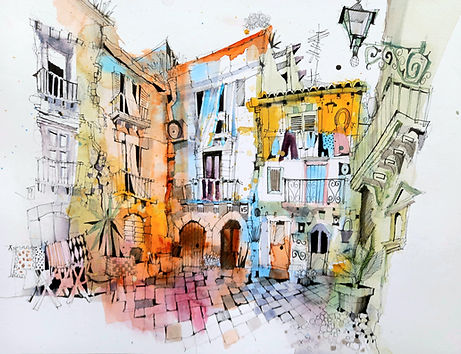
Catania, Sicily
