

When Two Women Make Meaningful Cinema Together


When two Women make Meaningful Cinema Together
An intimate conversation on ageing, mortality, memory, and the quiet courage of women who refuse to let old age define them.
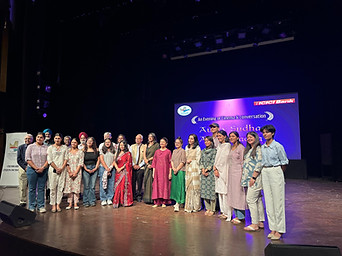
On a sweltering evening in Chandigarh, while the city simmered outside, the spirit inside Tagore Theatre was cool with reflection, warmth, and rare emotional honesty. The screening of the award-winning documentary Aunty Sudha Aunty Radha, directed by Tanuja Chandra and produced by Anupama Mandloi, turned into far more than a cinematic event—it became an intimate conversation on ageing, mortality, memory, and the quiet courage of women who refuse to let old age define them.
Hosted by the Chandigarh Citizens Foundation (CCF), an organisation committed to fostering dialogue and preserving India’s cultural ethos, the evening drew educators, professionals, community members, and, most hearteningly, a large number of young viewers. Their laughter, tears, and whispered promises to call their grandparents by the end of the screening said more than any formal applause could.
Known for her powerful women-centric films such as Dushman, Sangharsh, and Qarib Qarib Single, Tanuja Chandra has long been a filmmaker interested in women who resist silence. In Aunty Sudha Aunty Radha, she turns her lens toward old age—not as decline, but as a stage rich with agency, humour, dignity, and unexpected freedom.
The documentary follows two spirited elderly women who confront the realities of ageing with extraordinary grit and matter-of-fact wisdom. What struck the audience most was not merely their resilience, but their complete lack of fear when speaking about death. “Maut toh aani hai… toh kya karein? Intezaar karein—ke kab aayegi aur kab usmein baithenge.”
There was no melodrama in this acceptance, only clarity. It was this startling emotional honesty that formed the centre of the post-screening discussion moderated by Dr. Rachna Singh.
Her first question to Tanuja Chandra went straight to the heart of the film: what was the defining moment that made her choose this theme? Was there a creative trigger that compelled her to tell this story? Since the protagonists were also her buas, Dr. Singh asked whether that intimacy made filming easier or emotionally more difficult. The answer lay in the film itself—an affection free of sentimentality. Chandra’s camera does not pity; it listens.
Producer Anupama Mandloi was asked what drew her to such a deeply personal and unconventional project. In an era when cinema often chases spectacle, what made her invest in a quiet documentary about two elderly women and the emotional toll of ageing? It was a significant question, especially when longer life spans have become common, but emotional preparedness for ageing remains rare.
Another compelling thread of the discussion focused on how the film resists familiar cinematic stereotypes. Indian films dealing with old age often frame elderly people as victims—of neglect, loneliness, or family cruelty—as seen in films like Saaransh, Baghban, and Vadh. But Aunty Sudha Aunty Radha presses the refresh button on this. These women are not tragic figures; they are witty, stubborn, alive, and fully themselves. Was this refreshing perspective a conscious decision, Dr. Singh asked, or did it emerge organically from the lives of the women themselves?

Equally fascinating was the behind-the-scenes reality. As Mandloi shared, creating a documentary that is women-led, centred on ageing, and unapologetically niche is not easy in an industry driven by commercial viability. Financing such a film and finding distributors demands both persistence and conviction. Did they ever feel pressure to make it more “market-friendly”? The question revealed the invisible labour behind meaningful cinema.
To lighten the intensity, the audience was treated to stories from the filming process—funny, touching, deeply human anecdotes that revealed the affectionate chaos of working with family and the unpredictability of documentary filmmaking.
The conversation also widened to Chandra’s own journey in cinema. From Dushman (1998), where Kajol stood firmly at the centre, to Sangharsh (1999) with Preity Zinta, Chandra has consistently placed women at the heart of her narratives. She recalled how distributors once insisted she needed a male star like Sanjay Dutt to make Dushman viable. Yet she persisted. Has that glass ceiling truly cracked today? Or has it merely changed shape?
It was perhaps the most important question of the evening. Tanuja’ response was honest. Things had improved in the three decades since Dushman but not enough.
The final discussion turned to the creative dynamic between director and producer—moments of disagreement, collaboration, and trust that shaped the final film. And, fittingly for Chandigarh, someone asked whether they would ever make a film on Partition, considering every household in the city carries such stories.
As the lights dimmed and conversations lingered in the foyer, one thing was clear: this was not just a screening. It was an evening of remembrance, recognition, and reconnection.
When two women make meaningful cinema together, they do more than tell a story.
They remind us how to live.

Harmeet Singh & Rachna Singh with Tanuja Chandra & Anupama Mandloi
24th April 2026
About the Author
The Wise Owl Team