
The Interview

Harpreet Mand
A Sydney-based Contemporary Artist
Dr. Harpreet (Neena) Mand is a Sydney-based contemporary artist, architect, and academic of Indian heritage. Her practice explores relationships between body, landscape, and cosmos through an evolving framework she calls Dhvanic Abstraction, inspired by the Indic aesthetic principles of rasa and dhvani. Drawing on architecture, philosophy, science, and cultural narratives, her abstract paintings investigate interconnectedness, perception, and feminine perspectives on creation. Mand was awarded a PhD from the University of Sydney for her thesis Constructing Architecture and Interpreting Identity and continues to teach architecture. Working from her Hawkesbury River studio, her work reflects on migration, belonging, and humanity’s relationship with the living world.
The Interview : Harpreet (Neena) Mand
Rachna Singh, Editor, The Wise Owl, talks to Harpreet. (Neena) Mand, an Indian artist based in Australia.
Thank you Neena for talking to The Wise Owl about your art and creativity.
RS: Your work describes home not as a fixed place but as a lived, evolving relationship with nature. How did your migration shape your understanding of home, and how does the Hawkesbury River landscape influence this evolving sense of belonging in your work?
NM: Having lived in several countries, I have become very aware of how a sense of place emerges through the relationship between topography, light, vegetation, and culture. As an architect, these elements shape how we understand and inhabit a landscape.
Over time, I realised that for me home is not simply a physical location. It is a way of connecting with the natural world. Our larger home is the Earth and the universe itself.
When I moved to Sydney, I felt an immediate resonance with the landscape. Something about the vegetation, the light, and the deep geological time visible in places like the Blue Mountains felt familiar and grounding. I remember taking my aunt, who was visiting from India, to see the landscape, and she said, “You are living in God’s country.” That phrase stayed with me and inspired one of my paintings titled Vibration in God’s Country.
Living near the Hawkesbury River has deepened this sense of belonging. Our home overlooks the river, and each morning during Amrit Vela—the early hours before sunrise—mist rises from the water. In those moments the landscape feels deeply unified and contemplative.
For me, home operates at multiple scales. There is the cosmic scale of the universe, the planetary scale of Earth, the regional scale of place, and the intimate scale of the body and human relationships. Home is not just where we live physically—it is something we carry within us through memory, relationships, and sensory experience.
Sometimes it is even something as simple as a smell or a quality of light that evokes that feeling of being at home.
RS: In Dhyaan I – Body as Threshold, the body is imagined as the first dwelling where inner and outer worlds meet. How do you translate such an intimate, experiential idea of embodiment into the visual language of abstraction?
NM: As an architect, I have long been interested in the idea of the threshold—spaces that mediate between two conditions. A threshold belongs simultaneously to both sides: inside and outside. A veranda, for example, is neither fully interior nor exterior, yet it connects both.
I began to think of the body in a similar way. The body is our first home, but it is also a threshold through which we continuously exchange with the world. It is a sensing organism that absorbs impressions, breathes, perceives, and reformulates experience.
My interest in meditation and yoga also informs this thinking. The word Dhyaan refers to contemplation or meditative awareness. In that sense, the body becomes a site where perception, breath, consciousness, and environment meet.
In Dhyaan I – Body as Threshold, I wanted to evoke this experience rather than represent the body anatomically. Abstraction allows me to depict the body as a spatial and energetic condition rather than a physical form.
I use permeable boundaries, rhythmic lines, and swirling movements of dots and marks to suggest the constant flow between interior and exterior states. The composition reflects a reciprocal movement—breathing in and breathing out, sensing and responding.
Through abstraction, the body becomes a universal condition rather than a gendered one. It invites viewers to become aware of their own embodied presence—the moments when they feel grounded, attentive, and at home within themselves.
RS: Your concept of Dhvanic Abstraction draws from the Indian aesthetic principle of dhvani, or suggestion. How do you adapt this literary-philosophical idea into a contemporary visual practice, and what kind of viewer experience do you hope it evokes?
NM: My interest in Indian aesthetics developed during my doctoral research on modern architecture in India and Japan. While studying modernity and identity, I encountered the writings of thinkers such as Ananda Coomaraswamy and became fascinated by classical Indian aesthetic philosophy.
Two ideas in particular resonated deeply with me: rasa and dhvani.
Rasa suggests that the experience of art arises through a reciprocal relationship between the artwork and the viewer. Meaning is not simply delivered—it is experienced.
Dhvani, which was later articulated by Ānandavardhana, refers to suggestion or resonance. The deepest meaning of a work of art is not explicitly stated but evoked indirectly.
When I began painting, I realised that abstraction naturally aligns with this principle. Unlike representational art, abstraction does not prescribe meaning. It invites the viewer to engage with the work through perception and intuition.
In my practice, I extend this idea into what I call Dhvanic Abstraction. My role as the artist is not to declare meaning but to create conditions for suggestion. Through lines, dots, rhythmic repetition, and layered marks, the painting becomes a field of potential interpretation.
Each viewer brings their own history, memories, and sensibilities to the encounter. In that sense, the painting becomes new each time someone engages with it.
What I hope to evoke is first an intuitive resonance—something that draws the viewer in before interpretation begins. Ideally, the work creates a pause, a slowing down, where viewers become aware of subtle relationships between the painting and their own perception.
The painting is therefore less an image to decode and more an invitation to pay attention.
RS: The notion of porosity, drawn from your architectural background, plays a significant role in your work. How does this idea of porous boundaries help you explore relationships between the self, the viewer, and the natural world?
NM: Porosity, in a very fundamental sense, allows interaction to occur. If something is completely sealed, no exchange can take place.
A simple example is the traditional earthen water vessel—the ghada. Because the clay is porous, evaporation cools the water naturally. Through porosity, interaction leads to transformation.
In architecture, porosity refers to how spaces allow movement—of light, air, people, and perception. The most ecologically responsive buildings recognise these flows and design boundaries that filter, mediate, and respond to environmental conditions.
I began to think about porosity philosophically as well. Our identities are not fixed or isolated. We exist in constant exchange with our surroundings—with people, with culture, and with the natural world.
We breathe air, absorb light, share ideas, and respond to landscapes. Just as plants transform sunlight into energy, we too are continually shaped by our environment.
In my paintings, porosity appears through overlapping forms, permeable boundaries, and gestures that extend beyond the frame. Marks interact with each other so that distinctions between inside and outside become less rigid.
The viewer is not outside the painting but participates in completing the perceptual field. The work becomes a meeting point between awareness, environment, and perception.
This idea connects closely with ecological thinking and systems theory, which recognise that nature is not composed of isolated parts but interconnected relationships.
Ultimately, porosity allows me to explore interdependence—the understanding that self, environment, and cosmos are part of a continuous field.
RS: In works like Migrant Women Bridging the Invisible, you address displacement and layered identities. How do you navigate the tension between memory, ancestry, and present landscape when expressing migrant experience through abstraction?
NM: Migration often carries a dual experience. On one hand, there is expansion and opportunity. On the other, there is absence—the people, languages, and places one leaves behind.
When migrants move, they carry an idea of home within themselves while simultaneously trying to build a new one.
There are also invisible challenges—learning a new language, understanding unfamiliar cultural codes, and navigating systems of belonging. At the same time, small gestures of welcome can profoundly shape one's sense of home.
When I first moved to Australia, our neighbour came to our door with a welcome card and a gift. That simple gesture created an immediate sense of belonging.
In Migrant Women Bridging the Invisible, I explore this layered condition. Women often become cultural carriers—maintaining traditions, spatial practices, and memories while adapting to new environments. Migration therefore contains both continuity and transformation.
Through abstraction, I explore this tension without reducing it to literal illustration. The composition draws on ideas of thresholds, bridges, and doorways—spatial metaphors that suggest connection between past and present, memory and lived experience.
The work acknowledges displacement but also resilience. Migrants build new forms of belonging through relationships, communities, and cultural exchange. In that sense, home becomes something actively shaped rather than passively inherited.
RS: Your practice brings together ecological consciousness, feminist thought, cosmology, and cross-cultural philosophy. How do these frameworks converge within your visual language?
NM: My identity—and therefore my artistic practice—is shaped by multiple experiences. I have lived and worked in several countries, and each place has influenced how I think about the world. In many ways, I carry fragments of these places within me—India, Japan, Malaysia, England, and now Australia.
Rather than seeing ecological awareness, feminism, cosmology, and cultural philosophy as separate fields, I see them as different ways of asking related questions about existence.
Ecology examines interconnected systems. Cosmology explores the origins and structure of the universe. Feminist thought questions power structures and the visibility of different voices. Indic philosophical traditions often emphasise the unity underlying diversity.
These perspectives converge in my practice through a visual language of circles, networks, flowing lines, and layered fields. These forms echo patterns that appear across scales—from cellular structures and river systems to cosmic formations.
I am less interested in illustrating specific theories and more interested in creating visual environments where these ideas can resonate.
In this way, the paintings become spaces where scientific curiosity, spiritual reflection, ecological awareness, and cultural dialogue intersect.
RS: The overarching framework of The Unfolding Continuum suggests an ongoing inquiry rather than a fixed aesthetic position. At this stage of your journey, what new questions or directions are beginning to unfold for you as an artist?
NM: The idea of The Unfolding Continuum reflects how I approach my practice. I am not trying to arrive at a fixed style but to continue exploring questions that feel meaningful.
In my recent exhibition in Sydney, Primordial Pulse the artwork traces creation as a continuum — a vibration moving from formlessness to form, inviting the viewer to pause, reflect, and enter this continuum — to feel the vibration of creation, to encounter the spark that arises between rasa and form, and to experience the living dialogue between creator, creation, and observer.
One area of growing interest is our relationship with ecological systems—water, air, landscape, and atmospheric conditions. As both an architect and an artist, I am increasingly attentive to the living systems that sustain us.
Another direction concerns women's experiences—how power structures shape them, but also how women create new possibilities of becoming.
Dialogue is also very important to me—dialogue between cultures, traditions, and ways of knowing. What sustains this inquiry, however, is a sense of vismād—a feeling of wonder and awe at existence itself. Rather than responding to the world with despair, I am interested in cultivating attentiveness and gratitude.
Materially, I am also beginning to experiment with new mediums. Recently I explored printmaking and experienced a tremendous outpouring of ideas. I am also interested in scroll painting, inspired by both Indian pata traditions and Japanese scroll formats.
Installation is another direction I may explore further.
Ultimately, my aim is to create works that invite contemplation—a moment of pause where viewers can slow down, become present, and experience the quiet wonder of being in the world.
Thank you for sharing your thoughts with The Wise Owl
Some works of Harpreet (Neena) Mand
%201_%20Derrubbin%20Dawn.jpg)
Ambrosial Dawn
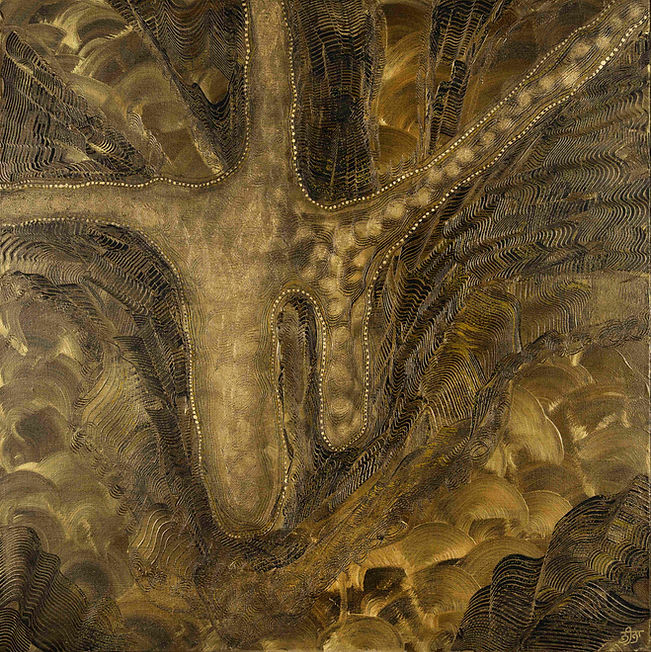
Dhyan (Contemplation)

Creation
