

Bad Bodies
How Modern Politics subverted Copenhagen's Ny Carlsberg Glyptotek
Naomi Leigh

Bad Bodies: How Modern Politics Subverted Copenhagen's Ny Carlsberg Glyptotek
A critical reflection on the Ny Carlsberg Glyptotek's "Petrified Ideals" exhibition, focusing on its use of contemporary interpretative texts to frame classical sculptures
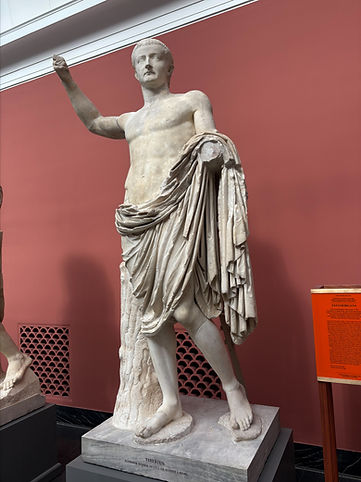
Last summer, as I walked among the marble busts in Copenhagen’s Ny Carlsberg Glyptotek, I was greeted by the museum’s extraordinary collection of ancient marble sculpture. There was the first century bust of Livia, the “black widow” of Rome and Emperor Augustus’ wife, an almost supernatural figure in Roman History who allegedly murdered everyone who stood in the way of her son’s ascendancy to the throne. It was an exemplar of Augustan classicizing style. with her braided hair, soft rounded features, and big eyes. As I met her gaze, I imagined the moment that Augustus met her, falling so instantly in love that he divorced his wife that very day to marry her, despite Livia then being pregnant with her second child. Further down the hall, there was the bust of Vitellius, with his fleshy face, under-eye bags and prominent double chin. It was no surprise that such a man was known for his voracious appetite, his short tenure as Roman Empire loaded with extravagant banquets of peacock brains and rare fish livers that fed thousands. And lastly there was the statue of Demosthenes, a Roman marble copy of the original Greek bronze made in 280 BCE by Athenian sculptor Polyeuktos. With his hands clasped tightly, his posture slightly bent and slightly forward, and his forehead riddled with wrinkles, this was a portrait not of physical perfection but moral seriousness.


And yet, these sculptures were not permitted to speak for themselves. Among the collection were burnt orange notes encased in glass, flanking many of the major works. Each orange panel had, in bold-faced sans serif black type, what the museum says are “personal reflections on gender roles, perfect and imperfect bodies, and everything we have inherited from Antiquity.” The notes, I later learned, are a part of the museum’s Petrified Ideals exhibition, which debuted in 2024.
Describing the notes as an “exhibition hack”, the museum invited eight contemporary voices of Copenhageners (authors, poets, and “opinion-makers”) to critique the marble bodies of the collection. Their critiques can be found in nearly every room of the building, some on placards attached to individual works and some as standalone signs.
Beneath one bust of a Roman woman, one of the panels describes the subject as: “A person, later identified as a ‘woman’, deemed ‘severe’ and ‘strong’ solely because their features are not classically feminine. Were they severe? Strong? Nobody knows. What we do know is that they’re smiling.”
It is not clarified why the note says she was “later” identified as a woman. Was this not apparent to the original sculptor in 30-50 AD, or to the excavators who later found it in the Licinian Tomb? Was her gender ever in doubt, as perhaps indicated by the note’s use of gender neutral pronouns? And why can we say with confidence that her tight lips indicate a smile, but not that her prominent browbone, forward fixated gaze, and sharp cheekbones are strong, or severe? These questions are not answered by the panel, nor are gender neutral pronouns used in any of the male busts. (The museum did not respond to my request for comment on these questions.)
At the end of the sculpture hall next to several draped figures is another burnt orange panel, this one suspended by wooden legs. Written by Moussa Mchangama, co-founder of “a strategic consultancy and change-making agency specializing in sustainability and social justice”, it reads: “Imagine if I had known that not all bodies have to look like this…Imagine if someone had told me before that this ideal—the youthful, white, muscular male body—is a mirage.” It goes on to ask without answering: “What does this mean for all the rest of us with other types of bodies? Bodies that aren’t white. Bodies that are big. Bodies that are old and wrinkled.”
As I read the panel, my thoughts returned to the chubby face of Vittelius, and to the prominent wrinkles lining the forehead and cheeks of Demosthenes. Was Mr. Mchangama excluding these works from his critique? Did those bodies, with their “imperfections” and departures from modern ideals of beauty, inspire him in a way that others did not? Was it perhaps referring to some of the more modern sculptures, like H.W. Bissen’s towering “Orsetes Fleeing from the Eumenides” (1950) or the protruding biceps and defined back muscles of Auguste Rodin’s works? And what did Mr. Mchangama mean when he called these bodies a mirage? Again, the commentary leaves us with more questions than answers, albeit questions that point us unmistakably in a modern political orientation.
The premise of Petrified Ideals is not, on its face, objectionable. Museums have long recontextualized their collections, and the classical tradition itself is nothing if not a continuous chain of reinterpretation. Yet something in the execution of Petrified Ideals left me feeling less like I was receiving an interpretation than an instruction on how I ought to view these sculptures in the context of modern social and political mores.
The physical form of the intervention is telling. The orange placards—glowing, insistent—convey an urgency which interrupts the muted harmony of marble and terracotta. They stand in sharp contrast to the greys and whites of the exhibition’s existing placards which describe in neutral terms the titles, origins, and artists of each piece.
The texts frequently frame the classical body not as an artistic achievement but as an ideological artifact—constructed, exclusionary, implicated in systems of power. Beauty is recast as a kind of social imposition in which idealization necessarily becomes erasure of those who do not neatly fit the ideal. One leaves not with a plurality of interpretive possibilities, but with a narrowing sense of what the works are permitted to mean.
Underlying the exhibition is a familiar impulse: to read the past through the moral vocabulary of the present. The Glyptotek itself acknowledges that the sculptures “show exactly what was once considered the ideal human being” and asks whether such ideals continue to “haunt” us today.
But the question is not whether the past influences us—it clearly does. The question is whether the past can be allowed to remain distinct from us, and what insights can be gleaned from centering interpretation of a piece of art around the identity of the artist and the subject itself.
This move reflects a broader tendency in the art discourse of the late 2010s and early 2020s, in which aesthetic judgment is increasingly subordinated to moral evaluation. As Dean Kissick argues in his Harper’s essay “The Painted Protest: How politics destroyed contemporary art,” much contemporary art has become “didactic, moralizing, and illustrative of pre-existing political positions,” rather than exploratory or formally ambitious. The work, Kissick argues, concerns itself less with discovering meaning and more with affirming it through its attachment to certain modern identities.
There is, of course, another way.
Glyptotek might present these contemporary reflections as one voice among many. It might juxtapose them with historical accounts, philosophical texts, or alternative readings. It might trust the viewer to navigate these perspectives without prescribing a conclusion.
Most importantly, it might allow the works themselves to retain their strangeness that comes with the passing of time, inherent in their distance from us and resistance to easy assimilation to the present moment. Doing so would leave these classical sculptures both alien but recognizable, with a vision of humanity that is at once distant, aspirational, and familiar. Perhaps such an approach would help the viewer to find meaning in the lives of people from the past that were very different from our lives today and which were guided by a set of aesthetic and moral beliefs that are equally different.
Petrified Ideals is an ambitious and, in many ways, well-intentioned exhibition. It seeks to animate the past, to connect it to the present, to make it speak in new ways. It also seeks to broaden the appeal of Greek and Roman sculpture to a modern European audience that is diverse, hailing from many places beyond the continent and across the world. But in doing so in such a way, it risks foreclosing the very openness that makes art enduring and that allows these marble bodies from millennia past to continue to awe and inspire us today.
As I departed Ny Carlsberg Glyptotek, I was greeted by the quiet gravitas of central Copenhagen. The museum opened onto Dantes Plades, a modest town square blending Nordic minimalism with the museum’s red-brick façade and Renaissance references. Just ahead was Tivoli Gardens, the Danish amusement park which inspired Walt Disney and which, with its eclectic architectural mix of Germanic, Chinese, and Moorish influences remained frozen in time with a playful wink and half-smile. Spread across the park was a charming mix of Japanese pagodas, German cottages, Chinese-style theatres, and Arabic palaces. I could hear the joyful shrieking of Danish children above on the park’s wooden roller coaster, designed to look like something out of a Brothers Grimm fairytale. Perhaps the past and present need not be at odds.
About the Author
Naomi Leigh is a writer, editor, and communications professional based in New York City and London.
