
Uncontained Lineages: The Resurgence and Global Evolution of Neo-Miniaturism
Team Wise Owl
For centuries, South Asian manuscript painting—whether Persian-influenced Mughal court illumination, fiery Rajput miniatures, or serene Pahari landscapes—was defined by intimacy. Created on painstakingly pressed layers of wasli paper, rendered with single-hair squirrel brushes, and meant to be held closely in private royal folios (muraqqa), the classical miniature was a world encapsulated in miniature bounds. Its visual language operated on restraint: flat architectural planes, intricate borders, and jewel-like pigments ground from lapis lazuli, malachite, and pure gold.
Yet today, this centuries-old tradition has burst wide open. Over the past three decades—and accelerating dramatically through the 2010s and mid-2020s—the genre has undergone a profound international renaissance known as Neo-Miniaturism. Rather than treating court painting as a static museum relic or a nostalgic craft, contemporary artists across Pakistan, India, Britain, and the United States have mobilized its delicate brushwork, non-linear perspectives, and detailed ornament as a potent conceptual weapon. In today's visual landscape, Neo-Miniaturism serves as a razor-sharp vocabulary to dissect colonialism, gender, empire, state violence, and the complexities of transnational diaspora identity.
The Genesis: Reclaiming the Wasli in Lahore and Baroda
To understand Neo-Miniaturism’s contemporary surge, one must look to its late-twentieth-century roots. Following Partition in 1947, traditional miniature painting in South Asia sat at a precarious crossroads. Under the dominant Western art historical lens, the genre was routinely dismissed as mere decorative "craft"—a colonial construct designed to demote indigenous non-Western aesthetics beneath European oil painting and modernist abstraction.
The initial structural turning point arrived at the National College of Arts (NCA) in Lahore, Pakistan, where master miniaturist Bashir Ahmed established a rigorous degree program in the 1980s. Students were subjected to grueling technical discipline—preparing paper from scratch, making squirrel-hair brushes, and perfecting pardaakht (fine hatching). However, once this technical foundation was mastered, a revolutionary generation of artists realized that the miniature’s formal language could be subverted from within to comment on contemporary political and personal anxieties under dictatorial regimes and societal pressures.
Simultaneously, at the MS University of Baroda in India, artist-scholars like Gulammohammed Sheikh and Nilima Sheikh were staging a parallel resistance. They actively rejected the Western modernist mandate that non-Western artists must adopt European abstraction to be considered "modern." Instead, they argued that South Asian visual history—specifically Pahari, Deccani, and Pichhwai manuscript traditions—already possessed a highly sophisticated, non-linear way of storytelling. For these artists, manuscript layout provided a far richer, native visual grammar for chronicling modern social upheaval, domestic life, regional poetry, and communal memory.
Shahzia Sikander: From Lahore to the Courts of New York
Few artists embody the transnational expansion and contemporary political weight of Neo-Miniaturism more completely than Pakistani-American artist Shahzia Sikander. Graduating from the NCA in 1990, Sikander ignited the Pakistani Neo-Miniature movement with her breakthrough BFA thesis, The Scroll (1989–90). By depicting mundane, domestic Pakistani life across a continuous manuscript layout using traditional gouache, she dismantled the century-old rule that miniatures could only depict historical royalty, epic battles, or religious myth.
Moving to the United States in the mid-1990s, Sikander translated her miniature training into an international, multi-disciplinary practice. Over the 2010s and 2020s, she propelled the genre far beyond the physical dimensions of paper. In digital animation films such as Parallax, Disruption, and The Last Post, Sikander takes thousands of individually hand-painted miniature elements and animates them across massive multi-channel video projections. Intricate patterns of gopis, colonial trade seals, and armless female torsos swirl across architectural walls, creating immersive visual allegories of historical trade routes and geopolitical fluidity.
Sikander’s work expanded onto the most prestigious global stages, including major solo presentations at the Venice Biennale collateral events, the Whitney Museum, the Brooklyn Museum, and a sweeping retrospective tour, Collective Behavior, spanning major American institutions.
In the public realm, Sikander’s practice reached landmark political significance through her public art project Havah... to breathe, air, life. The project featured NOW, an eight-foot bronze sculpture installed on the roof of the Manhattan Appellate Courthouse—marking the first time a female figure was permanently placed alongside historic legal icons on the building's facade. Incorporating ram-horn braids and an intricate lace collar as an homage to systemic justice and Ruth Bader Ginsburg, the work brought miniature iconography into monumental bronze. Its sister sculpture, Witness, featuring an Urdu calligraphy skirt, captured international headlines when Sikander intentionally chose not to repair the severed sculpture after it was vandalized at the University of Houston. By leaving the damage intact, Sikander transformed the miniature-derived sculpture into an unyielding symbol of artistic resilience against censorship and political hatred.
The Singh Twins: "Past-Modernism" and British-Asian Identity
While Sikander expanded the miniature into abstract sculpture and digital animation in the West, identical twin artists Amrit and Rabindra Kaur Singh—known collectively as The Singh Twins—were pioneering a parallel movement in the United Kingdom.
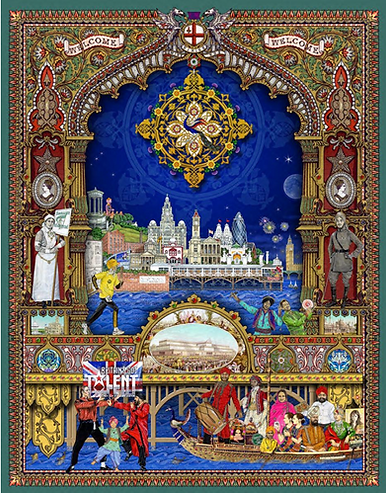
Growing up in Liverpool during the 1980s, the sisters faced severe pushback from British university art instructors who dismissed their interest in Indian court painting as backward, decorative, or derivative. In response, the twins coined their signature philosophy of "Past-Modernism." They asserted that traditional Indian manuscript conventions—flattened perspective, dense simultaneous narratives, decorative borders, and vibrant color—were visually superior for capturing the chaotic, multicultural reality of modern post-colonial Britain than single-point European perspective.
Working collaboratively on the exact same canvases, the Singh Twins achieved widespread international acclaim. In satirical works like Nineteen Eighty-Four and Rule Britannia, the twins blend classical Mughal and Rajput portraiture with contemporary icons. Figures like Queen Elizabeth I, media moguls, football stars, and political leaders appear alongside traditional courtiers, exposing the intersections of British imperialism, media saturation, and racial politics.
Throughout the 2010s and 2020s, their monumental exhibition Slaves of Fashion combined miniature hand-painting with giant illuminated fabric lightboxes and textiles, exposing how the historical Indian cotton trade was intertwined with transatlantic slavery, British industrial exploitation, and modern fast-fashion ethics. More recently, in their major exhibition Botanical Tales and Seeds of Empire at the Royal Botanic Gardens, Kew, the twins turned their miniature-derived digital and hand-painted lens toward economic botany. The series interrogates how European exploration and the East India Company weaponized plant hunting—such as cotton, indigo, and opium—to build imperial wealth. Awarded MBEs (Members of the Order of the British Empire) by Queen Elizabeth II and commissioned by the Royal Collection Trust for Buckingham Palace, the Singh Twins successfully forced the British art establishment to recognize South Asian miniaturism as an essential cornerstone of contemporary British art.
The 2010–2020s Renaissance: A Transnational Language
In the decade between 2010 and 2020, Neo-Miniaturism matured from a localized artistic revival into a dominant global movement spanning four continents.
In Pakistan, artist hubs around Lahore and Karachi utilized the genre to address state violence, censorship, religious orthodoxy, and gender dynamics—manifesting in site-specific architectural installations such as Imran Qureshi’s crimson-splattered pardaakht works on massive concrete plazas. In India, centers across Baroda, Hyderabad, and Rajasthan broadened the practice onto large-scale wasli canvases, employing natural mineral pigments and gold-leaf satire to interrogate caste oppression, state surveillance, historical trade, and climate crisis through artists like Varunika Saraf and Desmond Lazaro.
Meanwhile in Britain, diaspora artists focused heavily on decolonizing museum collections and exposing imperial trade networks through digital lightboxes and collaborative storytelling. In the United States, artists pushed the medium into bronze public sculpture, multi-channel video animations, and massive mosaic murals, directly challenging traditional notions of public monuments and female agency.
Today's Context: Why Neo-Miniaturism Matters Now
Looking at the world today, the relevance of Neo-Miniaturism has only deepened. We live in an era marked by intense political polarization, ongoing debates over public monuments, the decolonization of museum archives, and the rapid rise of algorithmic, AI-generated imagery. Within this exact contemporary landscape, Neo-Miniaturism offers two vital interventions:
First, it confronts the politics of memory. As institutions worldwide grapple with how history has been written, curated, and weaponized, Neo-Miniaturists use traditional craftsmanship to rewrite those archives. When The Singh Twins illuminate the colonial roots of botany or trade at Kew Gardens, or when Varunika Saraf paints modern socio-political dissent using historical gold leaf, they are not escaping into history. They are using historic visual codes to expose how yesterday’s imperial systems directly shape today's global inequality, climate vulnerability, and labor exploitation.
Second, Neo-Miniaturism acts as a radical defense of human touch and intentional slowness. In a contemporary media environment saturated with instant, synthetic visual content, the miniature discipline demands an uncompromising commitment to time. It requires the artist to spend hundreds of hours preparing paper, grinding mineral pigments, and laying down single hair-thin lines. In turn, it demands that the viewer stop, step close, and engage in intimate, slow seeing.
When Shahzia Sikander places a miniature-inspired female figure on a Manhattan courthouse roof, or when the Singh Twins map global economic trade routes through Mughal borders, they prove that ancient South Asian visual traditions are far from historical artifacts. Neo-Miniaturism has transcended its origins as a courtly manuscript craft to establish itself as one of the most vibrant, politically sharp, and globally significant art movements of the twenty-first century.

The Hour Glass, 2025 Shazia Sikander

Indigo: The colour of India, Singh Twins
About the Author
The Wise Owl Team