

Feisal Alkazi on “Bound”, Women, and the Practice of Theatre
Aradhika Sharma
Aradhika Sharma speaks with Feisal Alkazi about Bound, women’s histories, theatrical experimentation, and a creative practice rooted in curiosity, collaboration, and continual reinvention.
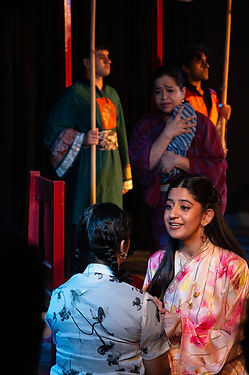
Recently staged at Gurgaon's beautiful Camera Museo, Feisal Alkazi's Bound is a magnificent production—visually evocative, emotionally resonant and theatrically assured. Drawing on the life and writings of Tan Yunxian, the sixteenth-century Chinese physician whose Miscellaneous Records of a Female Doctor (1511) preserved the experiences of women across social hierarchies, the play recreates the culture and ethos of Ming-era China through deft touches rather than grand spectacle. Dance, puppetry, shadow play, music and performance blend seamlessly into a theatrical language that feels both intimate and expansive.
At its heart lies the friendship between the granddaughter of a physician and the daughter of a midwife—an unlikely bond forged across social divisions and shaped by circumstance. Subtle yet often heartbreaking, the play explores women's lives in a society marked by hierarchy, duty and restriction while never losing sight of resilience, affection and self-determination. As the narrative moves from village life to the complexities of the imperial court, Bound becomes a moving meditation on memory, friendship and survival. It stands among Alkazi's most accomplished productions.
Across his work—and most recently in Bound—Alkazi's practice reflects a rare combination of intuition and intellectual discipline. Whether drawing from sixteenth-century China, Gorky's pre-revolutionary Russia, or contemporary Indian realities, his theatre resists easy categorisation. Instead, it searches for continuities—human dilemmas that transcend geography and time. His refusal to repeat himself, his commitment to experimentation, and his willingness to work beyond familiar spaces together define a creative philosophy grounded in exploration rather than comfort.
On Bound
It was Tan Yunxian's unusual position as a woman physician documenting the lives of other women that first drew Alkazi to the material.
“I first came across this story some years ago—the idea of a woman in 16th-century China who not only practiced medicine but actually documented her work.”
What interested him was not merely her medical practice but the rare vantage point from which she observed her world. The play continues Alkazi's longstanding interest in lives and histories often left at the margins of official narratives.
“At its heart, the play is about women—their relationships, their resilience, and the emotional worlds they inhabit.”
That concern unfolds through the friendship between the physician's granddaughter and a midwife's daughter, who meet again as adults and journey to the imperial court. Its theatrical language echoes that richness of experience.
“We're working across time, memory, and imagination,” Alkazi explains, describing a theatrical vocabulary that combines dance, shadow play, puppetry and live performance. Recreating “a China of that time” remains central—through costume, music and visual design—culminating in what he describes as “a roller coaster of emotions.”
On Gender and Women
Running through Alkazi's work is a sustained engagement with gender.
“I've always been drawn to gender-based issues… in different times and cultural contexts,” he says, tracing this impulse back to the 1980s and his involvement in early women's movements in Delhi. Over time, this concern has shaped audience expectations.
“Feisal ka play hoga toh women ka agency hoga,” he observes, adding that he is “quite happy to meet that expectation.”
One principle, however, has remained constant: “I've never done anything that is sexist or demeans women.” Yet, his approach is marked by restraint. Even when dealing with violence or exploitation, his theatre avoids spectacle, consciously distancing itself from representations that depend on “the sexualisation of women… and how they are represented.” Understanding rather than sensationalising remains central to his method.
“I try to understand the world of the play from within,” he says, seeking to engage with its history, social context and emotional reality in order to give these stories dignity and depth.
On Process, Collaboration, and Practice
For Alkazi, theatre begins in rehearsal, discussion and discovery—and never entirely leaves them. Even when working with a large ensemble, as in Bound—18 actors aged 12 to 70—what matters is not scale but the depth of engagement.
“We spent a lot of time discussing, improvising, and building the narrative together,” he says, describing rehearsals as spaces of exchange rather than instruction.
This approach encourages both collective ownership and personal investment. “You are more bought into it because you resonate so closely with it… it may reflect the stories that your aunt or your grandmother told you.”
What he seeks is not simply performance, but a deeper connection—an ability for actors to locate something of their own experience within unfamiliar worlds and fully inhabit them. Such openness is underpinned by careful scholarship. His work relies on extensive reading and research, yet the movement from text to stage demands transformation.
“The novel… is quite expansive… theatre demands compression.” The task lies in distilling material while retaining its emotional truth—what he calls “an inclusive and organic exercise.”
Underlying this approach is patience. “Cheezein dheere dheere hoti hain… The process is more important than the final product.”
Sustained through long-term collaborations, his practice unfolds gradually, structured by a daily rhythm of writing in the mornings and theatre in the evenings.
On Choosing Plays and Contexts
Feisal Alkazi gravitates towards material that demands reinvention. “If there's a play that I know how to do, I won't do it,” he says, gravitating towards projects whose form is not immediately apparent but emerges through instinct—when “something starts clicking” through text, sound or image.
This instinct is followed by deeper engagement with context. His staging of Gorky's The Lower Depths, for instance, resonates with contemporary India's realities of poverty and marginalisation, where those dismissed as the “scum of the earth” become figures of agency. This exploration also informed Barbaad, the Hindi adaptation of Lynn Nottage's Pulitzer Prize–winning play Ruined, developed in close collaboration with a translator.
“Not one person thinks Barbaad is not an Indian play,” he notes, underscoring its enduring universality.
On Performing Across Locations
Alkazi's theatre is equally shaped by its relationship to audiences. While Delhi provides a loyal base—“some have seen them 30–40 times”—he consistently seeks new contexts to re-energise the work.
From intimate performances in homes to institutional venues, productions travel across spaces with the same ensemble. “Why play the same old thing? The challenge is every time to create something new.”
His practice remains rooted in openness—“full freedom—chat, discuss”—and has long extended beyond formal stages, from art galleries and old havelis to outdoor spaces.Across these shifts, scale becomes crucial. “The kernel remains the same, but everything else changes,” he observes, noting how performance must adjust its energy and form depending on the audience.
On Writing and Beyond
Alkazi’s writing reflects the same principles that shape his theatre—intuitive, process-led, and grounded in lived experience. A childhood ambition to write a murder mystery, shaped by memories of his grandmother reading Agatha Christie late into the night, eventually led to The Artful Murders.
Even when drawing from real events—“we knew the girl who was murdered”—his work avoids sensationalism, instead taking the form of what he describes as a “chatpata… cosy murder mystery.” The narrative emerges organically, rooted in the textures of Delhi and shaped through revision and collective listening.
His work also extends into biography and history, including a recent book on Justice Sanjay Kaul, widely respected for his judgements on fundamental rights, federalism, and arbitration. Tracing “five… no, seven generations of a Kashmiri Pandit family from 1618 till today,” the study centres on Kaul’s family, mapping continuity and displacement across centuries.
Seven years in Kashmir were particularly formative for Alkazi. “I’ve worked largely with young men whose fathers had been killed,” he reflects—an experience that deepened his engagement with questions of identity and memory, informing works such as Discovering Kashmiris and The Guide to Srinagar.
Feisal Alkazi’s work is defined by a refusal to settle, and a belief that theatre must be made anew each time—through process, patience, and shared discovery.
Seven years in Kashmir were particularly formative for Alkazi.
“I've worked largely with young men whose fathers had been killed,” he reflects—an experience that deepened his engagement with questions of identity and memory, informing works such as Discovering Kashmiris and The Guide to Srinagar.
If there is a constant in Feisal Alkazi's work, it is a commitment to curiosity. Whether drawing on sixteenth-century China, contemporary India or the layered histories of Kashmir, he approaches each project as an act of discovery—patient, collaborative and open to surprise. Bound, with its emotional intelligence, visual richness and profound humanity, is the latest expression of that enduring belief.

About the Author
Aradhika Sharma is a writer and journalist with nearly three decades of experience across print, digital, and broadcast media. She has contributed articles, stories, reviews, and columns to leading publications and authored several books, including the bestselling Sunita Williams: Astronaut Extraordinaire, translated into multiple Indian languages. Her book Dear Agony Aunt draws from her years as an online advice columnist. Her diverse body of work includes children's journalism, radio scripting, personal biographies, online columns, and contributions to anthologies, reflecting a versatile and enduring commitment to storytelling.