
The Hundred Autumns of the Mother: Guptipara, Punya Mati, and Festivities
By Arindam Roy
How a Goddess, a Prince, and Twelve Friends Shaped Bengal's Greatest Festival
As the cool autumn breeze sweeps through Kolkata's old mansions, it stirs memories of the past. The air is filled with the scent of incense and the sound of prayers, transporting you to a bygone era.
This is the time of the Durga Puja, a festival that celebrates the arrival of autumn and is often referred to as the Shatad Utsav, or the festival of a hundred autumns. It's a story that weaves together the myths of Lord Ram's Akaal Bodhan, the twelve friends of Guptipara, and Bengal's sacred traditions, which have now spread to every corner of the world.
The War of the Century and the Elevation of a Goddess
A long, brutal war lasted a hundred years. It was a time of great turmoil, before the first colourful pandal was set up on a city street, and the sound of the dhak drumbeat echoed through the air, symbolising the rhythm of a civilisation's heartbeat. According to the ancient text Devi Mahatmya, part of the Markandeya Purana, a powerful demon named Mahishasura existed. He was born to a buffalo-demon father and a buffalo-mother, who were under a curse. Mahishasura was granted a special boon that made him nearly invincible – no man or God could kill him. With his newfound power, he grew stronger and stronger, forcing the gods out of heaven and declaring himself the ruler of the three worlds. For a hundred years, he dominated the cosmos, casting a dark shadow over the Universe.
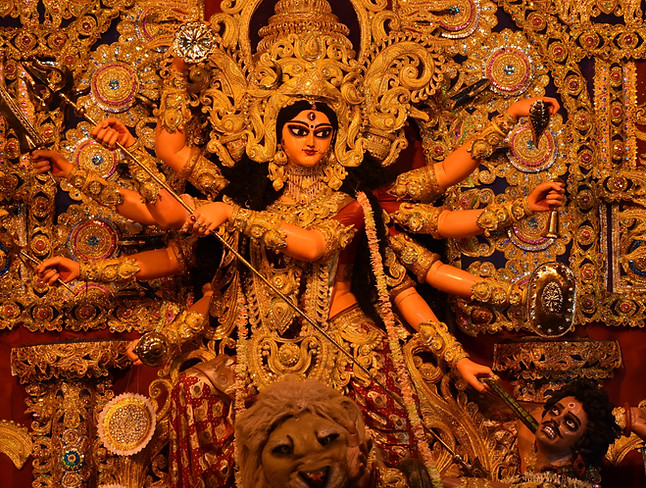
In desperation, the Gods found themselves humbled and homeless, sitting atop a mountain peak. Driven by their emotions, they did something remarkable. They took all their anger, sorrow, and unused power, every last bit of their energy, and let it come together in a single, shining form. From this intense collective energy, a Goddess emerged, radiant and fearsome, with ten arms and riding a lion. Each of her hands held a different weapon, given to her by the gods: Shiva's trident, Vishnu's discus, Indra's thunderbolt, and Varuna's conch. This was Durga, "the one you cannot pass", born to restore balance to the Universe, which could no longer bear the weight of chaos and disorder.
She answered the Gods' prayers, a powerful force created to restore harmony to the world. With her arrival, the Universe felt a sense of hope, a chance to redeem itself from the darkness that had taken over. Durga, the goddess of strength and courage, was ready to face the challenges ahead.
Durga battled Mahishasura, who kept changing forms - a lion, an elephant, and even a man. But no matter what he turned into, she stayed strong, always keeping her eyes on him. Finally, on the tenth day, known as Vijayadashami, she defeated the demon when he was in the form of a buffalo. With her sword, she cut off his head and ended the fight.
This is the core of Durga Puja: the story of how Durga, the Divine Mother, saved the day by killing the evil buffalo demon, bringing back what's right and just.
Sharad: When Mother Sleeps, the Season of Rest
In spring, people used to worship Durga in a big way, called Basanti Puja, during Chaitra Navratri. This is when the world is full of new life and colour, and the goddess is said to be awake and active. But another special time of year matters too. In the autumn, or Sharad, the air is cool and fresh, the sky is a deep blue, and you can feel the excitement of the harvest season.
According to tradition, this is when the Goddess Durga rests in a deep sleep, and the world around her is quiet and peaceful. It's like the whole world is waiting for her to wake up again.
The Goddess may be sleeping, but the world is still full of beauty and wonder, and anticipation hangs in the air. As the seasons change, people can feel the goddess's presence.
It's a time for quiet contemplation, and for thinking about the balance and harmony of the natural world. Festivals aren’t just about what’s proper, though; sometimes they are about what’s necessary. And necessity is often a hero in crisis.
Akaal Bodhan, or the Untimely Awakening, by Ram
Meet Lord Ram, Prince of Ayodhya, exiled in the forest, his wife parted from him, a warrior on the verge of the war that will define an age. He knows that Ravana is not just a mighty king; he is a devotee of Shiva, a master of boons, a strategist whose armies have already tested the limits of mortal bravery. Ram needs more than skill to win; he needs grace. He needs Mother.
It's not the right season for her to be awake; her time is in the autumn, not now. But in some stories from Bengal, like Krittibas's version of the Ramayan, this problem leads to a new kind of devotion. In an emergency, when it's a matter of doing what's right, you can call on the Goddess even when it's not her time, and she will respond.
So, Ram sets up the ritual in Ashwin, when the world is meant to be quiet, during the waning Moon. He collects 108 blue lotuses, each a symbol of devotion, each a petition written in petals. As the puja reaches its climax, one lotus disappears. In some versions, the hiding place is the goddess herself, who wants to see how far this lotus-eyed king will go.
As the story goes, Padma-nayana doesn't hold back. They compare Ram's eyes to beautiful blue lotuses. He's so determined that he's willing to give up one of his own eyes to make up for the missing flower. Just as he's about to do this, the goddess appears, beaming with a warm smile, and gently stops him. It's as if she's saying, "That's enough; your devotion is complete."
And with that, she blesses him, and her blessing changes the course of the war. In the fall, something amazing happens - the Akaal Bodhan, or the early awakening, which becomes a kind of legendary beginning for the Sharadiya Durga Puja. This is the story of how Ram called upon Durga for help, showing that when things are really tough and what's right is at stake, the Mother can be called upon, even if it's not the usual time.
This story is central in Bengal; it's the core of the festival, which is why the biggest celebration of the year is connected to the Ramayana, not just the Devi Mahatmya. It reminds us that Durga's power can be summoned whenever needed, and that's what makes this festival so special. Ram invoking her out of season shows that the Mother's power isn't limited to any particular time or occasion, and that's what makes Sharadiya Durga Puja so significant.
The Birth of Barowari: Guptipara and the Twelve Friends
The Devi Mahatmya gives us the cosmic war, and the Ramayana gives us the hero’s devotion. The story of Guptipara gives us something equally vital: the moment the festival stepped out of the zamindar’s courtyard and onto the street.
It was around the late 1700s, somewhere between 1760 and 1790, when a group of men tried to enter a Durga Puja celebration hosted by the Sen family, rulers of Guptipara village in Hooghly. But they were stopped at the door. Twelve Brahmin friends were not allowed in, and women were turned away too. Guards stood at the entrance, blowing whistles and holding sticks, making sure only certain people could enter while others had to stay out.
This created a clear line between those inside and those outside, and they enforced it strictly. A group of twelve friends, feeling angry and embarrassed, decided to take matters into their own hands and organise their own puja. They didn't want to have to rely on a rich family's permission, so they came up with a plan. They collected money from nearby villages, formed a committee, and started a community celebration open to everyone. This small act of defiance led to the creation of the term Barowari, which comes from the words "baro", meaning twelve and "yar", meaning friends. It let the community come together and celebrate without needing anyone's approval.
The twelve friends had sparked a new tradition, one that would bring people together and give them a sense of ownership and pride. And so, the Barowari puja was born, a celebration that would be run by the people, for the people.
Until then, Durga Puja had been a private celebration, mostly for the wealthy and aristocratic families. But now, it was transforming into a public event, a Sarbojonin celebration that welcomed everyone, regardless of their caste or family background. Over the next century, this new model of celebration spread like wildfire, from Guptipara to Kolkata and beyond, becoming the dominant way of observing the festival.
The Shatad Utsav, or hundred autumns, is more than just a way to count the years - it's a story of how a festival changed over time. It started in a palace, but now it's celebrated on the streets. At first, it was only for a certain family, but now it's for everyone. It's a time when a whole community comes together to think about who they are and where they come from.
Punya Mati and Nishiddho Palli: The Holy Soil of the Forbidden
The ritual of punya mati tells us how Durga Puja became ethically complex, even radical. In Bengal, every Durga idol starts in clay, much of it from the banks of the Ganga, but the clay is incomplete without a small portion of soil from a nishiddho palli, a "forbidden quarter": the front of a brothel.
One idea is that when a man enters a certain kind of house, he leaves behind his good qualities, like virtue and pride. The dirt at the door takes in these qualities, making it special. Another way to look at it is that the goddess needs everyone, even those who are often left out, to be complete. Yet another view is that it honours and purifies women often treated unfairly, seeing them as part of the nine forms of the feminine that some people worship. The ceremony is quite straightforward and low-key.
A priest or the person who makes idols goes to the entrance of a brothel, often in the well-known Sonagachi area of Kolkata, and humbly asks for some soil. A sex worker gives it to them as a gift. The priest says prayers, not to criticise, but to bless. Then, they mix the soil with clay from the Ganges River, cow dung, and cow urine to form the body of the goddess. They use this mixture to make the idol, a significant part of the ritual. The whole process is done with respect and care, showing that even in unexpected places, a deep sense of spirituality and connection to tradition can exist. The tradition has become more visible and contested in recent years.
A few sex-worker collectives, citing dignity and agency, have started to contest or reject the ritual, maintaining that their soil should not be a symbolic resource without their consent. Others defend it as a rare moment when a stigmatised community is ritually indispensable to the sacred. Either way, punya mati is one of the most thought-provoking elements of Durga Puja: a reminder that the Mother is made from the whole of society, including its most uncomfortable corners.
Durga Puja in Modern West Bengal: Art, Protest and Memory
Come to Kolkata today at Durga Puja, and you enter a temporary city of art, argument and memory. The festival has long transcended its ritual boundaries; the pandal is now a canvas, the idol a statement and the theme a manifesto.
In 2024 and 2025, the pandals showcased themes that could easily have been part of a modern art exhibition. They highlighted important issues like challenges to our Constitution, the struggles of migrant workers facing harassment in other states, the emotional impact of divorce on kids, the decline of joint families, the need for water conservation, and the benefits and risks of artificial intelligence. One pandal, Rupantar, which means "Transformation", used changing visuals to talk about change. Another, Badamtala Ashar Sangha, turned its pandal into a courtroom, complete with a "Lady Justice" statue, and asked visitors to think about the law, fairness, and power. Golaghata Sammilani's exhibit, "Break Fail", used installations to show the hurt children feel when their parents’ divorce, making invisible wounds visible. Naktala Udayan Sangha, on the other hand, took people back to the era of big, joint families with shared kitchens and crowded courtyards, which differs from today's smaller, nuclear families.
These pandals were a great way to use art and culture to spark conversations and reflections about the world we live in. Some pujas have been overtly political, highlighting genocide, secularism and migrant rights; others have been quietly contemplative, honouring fathers, mourning lost traditions or re-centring community over awards.
This is Durga Puja as “protest art,” as a social cause, as collective therapy.
Probasi Bangali: Durga Puja
No matter where Bengalis go, whether for work, study, or to start a new life, they always bring Durga with them. In cities like Delhi, Mumbai, Bangalore, Pune, Chennai, Hyderabad, Allahabad, Varanasi, et al, local community groups come together to recreate the magic of Durga Puja, just like they do back home. They set up vibrant festivals in places like CR Park in Delhi, Powai and Andheri in Mumbai, and Ulsoor in Bangalore, filling the air with the sound of the dhak drum, the smell of delicious bhog food, and the sight of people dancing with dhunuchi.
At night, under the twinkling fairy lights, people gather to chat and share stories, keeping the spirit of the festival alive. This way, even when they're far from home, Bengalis can still feel connected to their roots and celebrate Durga Puja with the same joy and enthusiasm as they would in their hometowns.
As the festivities come to an end, people are left with a sense of longing, but also with the knowledge that they will come together again next year to celebrate Durga Puja. Food is a big part of this special Puja celebration, even when it's taken outside its original home.
Traditional Bengali dishes like luchi-alur dom, cholar dal, beguni, and mishti doi are always on the menu, even when made with local ingredients. In some cities, restaurants even create special menus just for the Puja. And in others, the food served at the pandal, called pandal bhog, brings back memories of home and becomes a big part of the celebration. This festival is not just about religion; it's also a way to share Bengali culture with others.
Across the Seas: Durga Puja in the Global Imaginations
Durga Puja isn't just an Indian thing; it's also big in other places where many Bengalis live, like London, New York, New Jersey, California, Toronto, Dubai, Singapore, Tokyo, and Sydney. For ten whole days, a little bit of Kolkata comes alive in each of these cities: they set up a special pandal in a community hall, or maybe in a temple basement, or even in a rented warehouse or a park where they can do the immersion ceremony. It's like a mini-Kolkata in each of these places, and it's really something special.
For Bengalis living in the Gulf, Durga Puja is one of the few times they can come together and feel like they're back home. Many work far from family and friends, but employers often understand how much this festival means to them and support them in celebrating it. The festival's global celebrations are not mere replicas, but unique adaptations that have evolved to fit local contexts.
In this sense, Sharad Utsav is no longer just a century-old tradition of Bengal, but a vibrant global celebration that has learned to express itself in many languages while still retaining its cultural roots and authenticity.
UNESCO’s Recognition: Living Heritage
Kolkata is home to a vibrant festival that UNESCO has recognised as a significant part of humanity's cultural heritage. In December 2021, UNESCO added "Durga Puja in Kolkata" to the Representative List of the Intangible Cultural Heritage of Humanity.
This recognition is not just for a specific ritual or event, but for the festival as a dynamic, multifaceted tradition that comes alive every autumn. The festival is a true celebration of art, music, devotion, and community spirit, bringing together people from all walks of life. From the skilled idol makers of Kumortuli to the talented designers and carpenters who build the elaborate pandals, everyone plays a vital role in making the festival a success.
The sound of the dhak, the delicious bhog prepared by cooks, and the countless volunteers who work tirelessly behind the scenes all contribute to the festival's magic. The festival is also a platform for public debate and discussion, where important issues like secularism, migration, and social justice are addressed.
For the people of Kolkata, the UNESCO recognition is a source of pride and a reminder of their responsibility to preserve and protect this precious cultural asset. Durga Puja is not just a festival, but a way of life that brings people together and transcends borders. As the festival continues to evolve and spread to new parts of the world, its significance only continues to grow.
Why the Story Is Important
The story of Sharad Durga Puja is more than just how a festival came to be - it's about how people deal with tough times and find strength. The Devi Mahatmya says that when things get really bad and no god can handle it, the Divine Mother shows up with all her power. Then there's Akaal Bodhan, which teaches us that when we really need it, our devotion can change everything.
Every year, people come together to celebrate the rebirth of the Mother, and it's not just a story - it's a memory that lives on. The hundred-year war is fought and won, but it's not just a battle in the heavens; it's a victory in the hearts of those who gather to witness the goddess waking up.
As the years go by, the story of the festival grows, and it's as if the celebration itself is learning and evolving, just like us, to understand what it means to be a mother in a world that's always changing. The festival is like a living thing, getting a little bigger and more meaningful with each passing year, and it's a reminder that even though things change, some things remain the same – like the power of a Mother's love.

Arindam Roy is a veteran Indian journalist, author, and poet with over 40 years of newsroom experience. He is the Founder, Editorial Director, and Editor-in-Chief of Different Truths (differenttruths.com), a global participatory social journalism platform. He also happens to be the festival Director of Shantiniketan Literarture Festival