
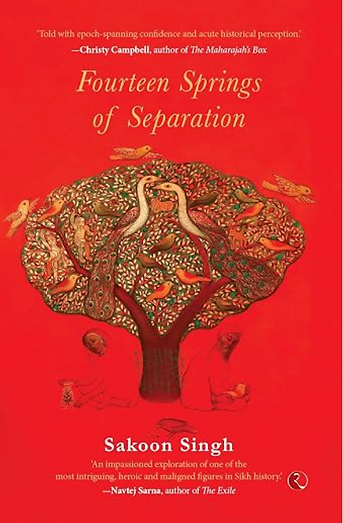
Fourteen Springs of Separation
by Sakoon Singh
Rupa Publications, 2026
A Queen Beyond Colonial Shadows
By Nidhi Rana
The novel begins as Rani Jindan Kaur speaks: “I had broken out of prison, but I wasn’t free yet”, a statement that echoes the collective anxiety of all Punjabis as the British relentlessly expanded their empire.
In Fourteen Springs of Separation, Sakoon Singh delivers a brilliant story that serves as both an intimate reclamation of history and a gripping postcolonial narrative. At its heart is the fierce and tragic legacy of the last Sikh queen, Jind Kaur, the youngest wife of Maharaja Ranjit Singh, whose life was systematically upended by the British Raj.
Singh masterfully pieces together the fragments of the queen’s trajectory as she is mercilessly wronged by the colonialists. She brings out the vulnerability of a queen who was painted as the “Messalina of Punjab”—an Orientalist campaign designed to discredit her intelligence, independence, and political power—who was separated from her young child and then incarcerated at Chunar Fort. She underscores Jind Kaur’s resilience and enduring strength as she recounts her extraordinary escape on foot to seek refuge in Nepal and, finally, her moving reunion with her son, Duleep Singh, at Spence’s Hotel in Calcutta after fourteen grueling years of forced separation, or “banwas” (285), the profound milestone that gives the novel its evocative title.
What elevates the novel beyond standard historical fiction is its structurally brilliant parallel narrative. Singh introduces us to three contemporary characters separated by geography but bound by their obsession to learn more about the last Sikh queen and her exiled son, Duleep—Mehr in Chandigarh, Sam in London, and Angad in Bangalore. These modern characters sift through the deliberate silences, erasures, and distortions left behind by British colonial authorities. By using these characters to unearth clues intentionally obscured by the empire, Singh skillfully bridges different eras. The modern investigation becomes a direct confrontation with historical amnesia, exposing how colonial powers actively manufactured archives to control the narrative of the Indian subcontinent. The emotional connection these characters forge with Jind Kaur mirrors our own awakening as readers to the layered trauma of history.
A particular triumph of the novel is Singh’s sophisticated command of language. While weaving Punjabi words into the English text, she avoids the clunky, disruptive translations that often stall postcolonial fiction. By using words like “sukh saandh”, “goosalkhana”, “satt samundar”, “ehsaan faramoshi”, “namak halal”, and many other colloquial expressions, Singh’s prose balances cultural authenticity with seamless reader accessibility, allowing the meanings of native terms to emerge naturally through narrative context. The language feels alive and breathing, and the narrative remains fiercely rooted in its cultural milieu. At the same time, one can catch a glimpse of the Professor of English Literature in Singh, as she has Mehr compare Rani Jind Kaur to The Madwoman in the Attic and read Jack Kerouac’s On the Road to better understand her situation with Angad.
The novel ends at a point where Rani Jindan Kaur’s narrative reaches a satisfying conclusion, but we see Duleep awakened and fiercely resolved to fight for the Khalsa Raj, leaving fertile ground for a sequel.
In a private discussion with Singh, she mentioned that ending the novel in Pondicherry was a deliberate choice because it was the base from which the Sandhawalias kept the spirit of the Khalsa Raj alive, hoping that Duleep would eventually be crowned King of Punjab. As a reader, I hope the author finds the creative fortitude and necessary leisure to pursue a second volume, for the novel is more than a retelling of a forgotten queen’s resilience. It is an interrogation of the archive itself.
Sakoon Singh has written a beautiful and vital book that proves history is never truly buried; it is simply waiting for those with the courage to go looking for it. After all, “mitti frologe taan sach aape bol payega”—if you dig through the dirt, the truth will speak for itself.
About the Author
Sakoon Singh

SAKOON SINGH read English Literature at the Jawaharlal Nehru University and Panjab University. A recipient of the Fulbright Fellowship, she currently teaches Literature and Cultural Studies in Chandigarh. She has published her academic writings extensively, including contribution to Cultural Studies in India by Routledge. She has served on the editorial team of prestigious journals, Dialog and E3W Review of Books. She has written pieces, articles and op-eds on literature, art, culture and aesthetics for The Tribune, Hindustan Times, DNA and The Quint. She has recently been selected as Associate Fellow at IIAS, Shimla. When she is not indulging the written word, she is walking the wilds or listening to Jazz. She lives in Chandigarh with her husband and son. She has authored two novels including Fourteen Springs of Separation

Dr. Nidhi Rana is an Assistant Professor in English in Chandigarh. Recipient of the prestigious State Award 2021 for her meritorious service, she has also edited two Coffee table books for the UT Chandigarh Administration. Other than scriptwriting and Voice-overs for documentaries, she has worked extensively on various platforms with the Chandigarh Administration. Besides academic research, she indulges considerably in reading. She writes poetry and short stories to give voice to her experiences as she passionately engages with life. Her first book of poetry titled ‘Of Love, Longing and Other poems’ was published in August 2023. Her second book of poetry titled ‘My Maverick Muse’ was published in May 2025. She is presently working on her third book, a book of stories based in Himachal Pradesh, which falls under the genre of Children’s Literature.