
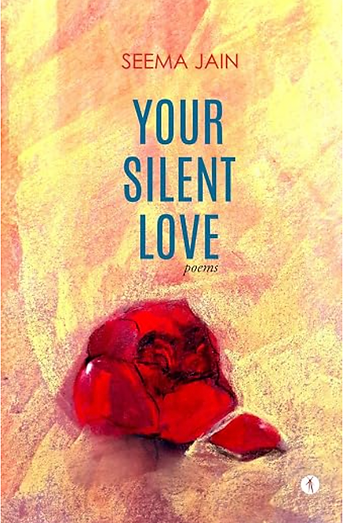
Your Silent Love
by Seema Jain
Hawakal Publishers, 2026
When Silence Becomes a Voice
By Sushmindar Jeet Kaur
The gleam of sunshine in my window
In the misty chill of December
Warmed my cramped bones.
I became accustomed to it!
Seema Jain’s Your Silent Love is a poetry collection that unfolds with uncommon composure and thematic depth. Comprising 81 poems, it does not merely gesture towards love in the conventional sense; rather, it uses silence as a prism through which memory, vulnerability, social tension, and inner endurance are refracted. The volume is notable for its restraint. It resists the temptation to disclose everything at once and instead allows feeling to emerge gradually, through image, cadence, and reflective pressure.
The title poem, “Your Silent Love,” gives the collection its interpretive centre. In this poem, silence appears not as absence but as a charged presence — one that holds longing, grief, tenderness, and unresolved memory.
The fragrance of roses around me
Grew in sweet abundance
And filled me to the brim.
I became accustomed to it!
Your love, my love! Silent, ubiquitous,
Fragrant like a rose,
Comforting like the winter sun,
Blissful like the cool drizzle,
All along the zigzag paths of life,
Making each step a joyride,
And for long, I remained accustomed to it!
Till one fine morning, I woke up from a nightmare
Of life without you!
And I understood how much they mattered—
The rose, the sunshine, the rain showers, and your silent love. (19)
Love itself is not presented as a transparent sentiment. It is fragile, shadowed, and resistant to neat articulation. In this respect, the title poem sets the tone for the book as a whole: it suggests that the most durable emotions are often those that cannot be fully spoken, only carefully approached.
The collection’s range is one of its defining qualities. Its poems move among domestic spaces, public violence, childhood recollection, mythology, nature, and the shifting textures of contemporary life. Yet this variety does not undermine coherence. On the contrary, it reveals a carefully sustained poetic intelligence — attentive to the emotional weight of ordinary experience and to the larger structures that shape private lives. She writes in “The Abandoned Cake” that:
Departing from the confectioner’s shelf
With jam-quoted words borne on its bosom,
An ardent message, tender, delicate, intense,
For a special one on a special day!
Who could ever foretell its tragic fate?
How could something so enticing to hearts,
And so tempting to taste buds,
Enveloped in such a beautiful love-wrap,
Ever encounter such a brutal end? (22)
Seema Jain’s writing is lucid without being plain and contemplative without becoming diffuse.
A central concern of the volume is the condition of women, especially the quiet burdens that accompany domesticity, silence, and inherited expectations. These poems are most effective when they leave tension unresolved, holding the social and emotional dimensions of experience in delicate balance. Rather than speaking in overtly declarative terms, the poet often lets implication and image carry the emotional argument, lending Your Silent Love much of its elegance, quiet intensity, and restraint. The poem “Slap” is among the collection’s most searching pieces. Its portrayal of domestic violence is rendered through sparse yet precise detail: smashed plates, thrown food, and utensils flung against walls. Such images do not merely illustrate cruelty; they expose the instability of the domestic space itself. The poem’s force lies in its refusal of excess. Violence appears not as spectacle but as a corrosive presence within the mundane. In this way, the poem achieves its effect through understatement rather than emphasis.
Some slaps fall on the face
And are visible, palpable
Some invisible slaps
Fall imperceptibly
On the soul. (34)
The collection’s social consciousness extends beyond the household to include war, terror, and collective suffering. These poems do not announce their seriousness; they earn it through measured language and ethical attention. The poet’s engagement with violence is most persuasive when she resists abstraction and stays close to the human cost of historical force. There is a clear sense here that poetry may bear witness without becoming propagandistic and may speak of pain without exhausting it through repetition.
A father’s trauma;
Some unknown face
In a news clipping,
The flash of a moment,
And the gut-wrenching anguish,
A strange dialogue, a connection
Across miles,
Across continents,
Across race, caste, and creed!
Cold-blooded shooting
Of his teenage son
By armed soldiers
‘Threatened’ by this 13-year-old boy! (41)
At several points, the volume turns towards nature, and these poems offer some of its most sustained moments of repose. Rivers, hills, trees, and seasonal movement are not treated as decorative motifs but as structures for reflection. In “Scream,” the poet’s concern extends beyond the personal into the realm of collective human suffering, as in the poignant lines:
And do we have the ears to hear the anguished screams of those
Who are doomed to traumatized lives
Despite our tall claims and vows?
Their shrieks reverberate in the air, redolent with their sighs;
For each of their tragic woes, tears fall from the angels’ eyes.
These lines serve as a powerful reminder of society’s moral responsibility towards the wounded, marginalised, and forgotten. The poet questions the sincerity of humanity’s professed ideals and compassionate promises as countless individuals continue to endure pain, trauma, and neglect. The imagery of cries reverberating through the air and angels weeping over human suffering deepens the poem’s emotional intensity, transforming personal empathy into a universal appeal to conscience and action. Through these evocative verses, Seema Jain urges readers not merely to acknowledge suffering from a distance but to listen, feel, and respond with genuine compassion. The passage reflects her deep humanistic vision and reinforces one of the collection’s central concerns—the need for empathy, sensitivity, and shared responsibility in an increasingly indifferent world.
Her poems on nature offer a language of continuity in contrast to social fracture and a sense of rhythm in which human life appears precarious. These poems are especially effective because they do not sentimentalise the natural world; they use it as a means of thinking through time, survival, and order. “Isn’t He Dangerous?”, “Song of Nature”, “Murraya Koenigii (The Curry Leaf Tree),” and many other poems convey this message.
The memory poems, too, are notable for their tact and emotional precision. Their evocation of childhood games and pre-digital daily life is warm, yet never merely nostalgic. Memory here serves as a mode of recovery and a form of cultural witnessing. The poet preserves the textures of an earlier world while remaining mindful of its distance from the present. That balance between intimacy and perspective gives these poems a particularly mature quality.
Like Trishanku, he stands today,
Torn between the pull of his homeland, his kith and kin,
And the proximity of his son, now busy in his own life.
And life’s Nemesis seems to catch up with him. (46)
A further dimension of the collection lies in its engagement with mythology. Seema Jain returns to inherited stories not to repeat them, but to reopen them. She presents different viewpoints in her mythological poems, such as “Kurukshetra—Between War and Peace,” “Amrapali,” “Ram: An Ideal,” and “Kaikeyi: The Restless Soul.” She says in “Gandhari’s Wish”:
In retrospect, I sometimes wonder if it was a wise decision
To blindfold myself for life and follow in your footsteps. (81)
Her treatment of myth is quietly revisionary, particularly in how it attends to women whose roles have been fixed by tradition. “De (Re)constructing Savitri’s Tale” and “Philomela’s Tongue” fall under this category. These poems invite the reader to consider what has been omitted from canonical narratives and what forms of silence have long been mistaken for meaning. The mythic register thus becomes one of inquiry rather than closure.
Formally, the poems are marked by clarity, control, and tonal balance. Seema Jain’s language is accessible yet measured, and the poems rarely strain towards display. Their strength lies less in verbal ornament than in the precision of observation and the discipline of arrangement. Its best poems are those in which thought remains embedded in image and emotion rather than standing apart from them.
Ultimately, Your Silent Love is a collection of quiet distinction. It is thoughtful rather than emphatic, observant rather than declarative, and emotionally serious without being overbearing. Its achievement lies in its ability to hold together lyrical delicacy, social consciousness, personal memory, and historical awareness. Seema Jain writes with a poet’s patience and a critic’s alertness; the result is a body of work that invites slow reading and rewards it with layered meanings. In a literary landscape often drawn to immediacy, this collection stands apart for its composure, intelligence, and subtle authority.
About the Author
Seema Jain

Seema Jain is a bilingual poet, short story writer, translator and editor, who retired as Vice Principal, Dean Academics, Associate Professor and Head PG Dept of English from KMV Jalandhar after 39 years of teaching the English language and literature to postgraduate and undergraduate students. Her twelve publications include four solo poetry collections with one co-authored and two more in the process, a book of poems translated from Hindi to English, two translated novels (one from the Sahitya Akademi), two edited books of research articles and two poetry collections. She has also contributed poems and short stories, interviews and articles to nearly 100 reputed international and national Journals/e-zines like Setu, International Writers’ Journal etc. Her poems are housed in Stanford University’s digital archives on Life in Quarantine, and her poems and short stories have been widely published, translated, anthologized and recited during International Poetry Conferences, Webinars, and on social media platforms, TV and Radio. Recipient of Purvottar Hindi Sahitya Academy Award, ‘Master of Creative Impulse’ Award and Punjab Kala Sahitya Academy Award, she is the Founder-President of Litspark: A Literary Forum and part of many prestigious literary bodies.

Sushmindar Jeet Kaur, an educationist, poet, storyteller, translator, editor, and awardee, is working as an Associate Professor and Head of Post Graduate Department of English, G.G.N. Khalsa College, Ludhiana. M.Phil in Anthropological Linguistics and Ph.D. in Indian English Literature, she has recently brought out collections of poetry under the titles Voices From Within and The Tapestry of Heartstrings, A Journey Towards LIGHT. Besides editing sixteen books, she translated The Blue Potter by Ajeet Cour, Why Are You Sad? By Kulbir Badesaron and Sikh Soldiers in Italy: Second World War. She has been anthologised in various journals and books. Besides, she is working on other projects, including translations of the books of major authors. Furthermore, she has presented research papers at international and national conferences in India and abroad, and delivered extension lectures in India. Her areas of interest include Indian Writing in English, Immigrant Writing, and Partition Literature. She is the Associate Editor of UGC Care-listed, Peer-Reviewed Journal LITERARY VOICE, Editor of the poetry section of INNSAEI, Editor of the Punjabi section of “Matru Akshar”, and Deputy Chief Editor of LITERARY JOURNAL of AESTHETICS.