
TALKING BOOKS

Rachna Singh, Editor, The Wise Owl talks to Vinita Agrawal about her latest book The Hour of God Published by Red River

Talking Books
With
Vinita Agrawal
Rachna Singh, Editor, The Wise Owl talks to Vinita Agrawal who has authored seven books of poetry. Her latest collection of poetry published by Red River, is about impermanence and interconnectedness. Her poem Conversation with a Seed won an award at Brew Poetry in 2025. She also received a prize for her poem The Light Phenomena from Science Fiction and Fantasy Poetry Association (SFPA) in 2025. She was the Runner-up for Mānoa poetry prize 2025 and was awarded the Jayanta Mahapatra National Award for Literature 2024, the Proverse Prize Hongkong 2021, the Rabindranath Tagore Literary Prize 2018 and the Gayatri GaMarshMemorial Award for Literary Excellence, USA 2015. She convened the PEN All-India Centre at Prithvi Theatre, Mumbai and Her work has been published in Gallerie, Global South, Pratik, Mascara Review, Indian Literature, Asian Cha, Voice and Verse, Tiger Moth Review, among others.
Thank you for taking time to talk with The Wise Owl.
RS: The Hour of God is described as a sustained meditation on time and impermanence. How did this thematic unity evolve—did you conceive it as a cohesive work from the outset, or did the poems gradually begin to speak to each other?
VA: The latter would be more accurate - the poems gradually began to speak to each other and a theme of impermanence residing within the folds of time began to emerge.
RS: Your poems seem to dwell in the contradictions of modern life—our awareness of ecological collapse alongside our participation in systems that sustain it. How do you personally navigate this “double-think,” and how does poetry help reconcile or expose it?
VA: I’m deeply pained and concerned about contradictions in modern life. On the one hand we all revel in what development and technological progress has to offer us in terms of lifestyle and convenience but on the other hand, despite being aware of the environmental price development extracts from our planet, we seem helpless to do anything about it. Are we really helpless? That is the question. Can we not strike a balance between progress and conservation? I’m a firm believer that we can. A careful study of development plans and a paring down of excessive damage to the environment can be certainly arrived at if the policy makers and the companies involved act on these lines. We need a wholesome, compassionate approach when we execute plans of progress both in urban and rural areas.
I’m afraid poetry does little on the actual ground of construction, and exploitation but the good news is that it does a lot in sensitising the readers and the public. It brings about awareness and empathy. It helps towards creating pressure groups that bring about actual change. I’m a firm believer that if the microcosm changes, the macrocosm changes automatically. This means that if one, individual mind changes for the better then that multiplies manifold and society as a whole also changes positively. In that sense poetry becomes the right vehicle for carrying the right message.
RS: There’s a strong ecological undercurrent in your work. Do you see poetry as a form of environmental witnessing, resistance, or something more inward and reflective?
VA: You’re right about the strong ecological undercurrents in my work. It is a natural, inbound thing with me. I don’t have to strive for it. If you notice, all my metaphors also are drawn from nature. Let’s say, nature is second nature to me. It is probably because of the deep love I have for nature as a whole - plants, animals, birds, insects, forests… they reinforce me. I cherish them the way I cherish my family. To come back to your question - yes, it’s inward and reflective to me. Nature is the biggest bank of love and compassion. It has an amazing pattern of justice to it.
RS: Rishi Dastidar mentions that your poems teach us “how to keep you and your soul together.” In times of crisis, personal or planetary, what role does poetry play in sustaining inner coherence?
VA: Now here is a space where poetry works at its most optimum- in keeping “you and your soul together “ I’m grateful to Rishi Dastidar for his kind and insightful comments. He’s put it perfectly. For me personally, poetry is how I process my thoughts. I write poems because I have something to say. Poetry offers coherence to the chaos of thoughts. Whether the crisis is personal or planetary, poetry offers a kind limb of sorting out right from wrong, a beautiful branch where fresh thoughts bloom and they seem to emerge from the deepest recesses of your mind and soul.
RS: Many readers speak of the emotional openness and empathy your poems evoke. How consciously do you write toward empathy, and do you think poetry can still shift collective feeling in a distracted, fast-moving world?
VA: My poems are written instinctively. While I’m conscious of what my words are saying and where they are directed, the truth is the the thrust, the propulsion towards evoking empathy is completely unconsciousness and intuitive. I’m a great believer in the power of poetry. Poetry is as sacred to me as a prayer. I believe one hundred percent that poetry can shift collective feeling in a positive direction, despite our fast-paced lives. In a distracted, scrolling world, poetry is the pause, the moment of light and goodness.
RS: Your work has also been described as tranquil and introspective. How do you balance stillness and urgency in your writing, especially when addressing themes as pressing as ecological crisis and late-stage capitalism?
VA: I’m calm by nature, something I’ve inherited from my father. But that doesn’t mean that an ongoing ecological crisis won’t fluster me. It will, it does. So I channel that out via my poetry. Late-stage capitalism is most frustrating. Whether we talk about inappropriate waste disposal methods from industries or the ruthless exploitation of the earth’s resources, these are matters one must address through action on the ground as well in areas of intellect and creativity. I address these themes in my work but with the inherent calm that is characteristic of my writing. Sounds like a paradox, but hopefully it’s working.
RS: What do you hope lingers with readers long after they have turned the final page of your book?
VA: The feeling of wholeness, wholesomeness and interconnectedness despite impermanence , that is what I want the readers to take away from this book. I hope the book facilitates feelings of compassion, empathy and sensitivity in my readers. Above all, through The Hour of God, I urge my readers to nurture feelings of hope and aspire for a better life while making sense of the realities around us.
Thank you for talking about your latest book Vinita. We wish you the best in all your future literary endeavours.
About the Poet

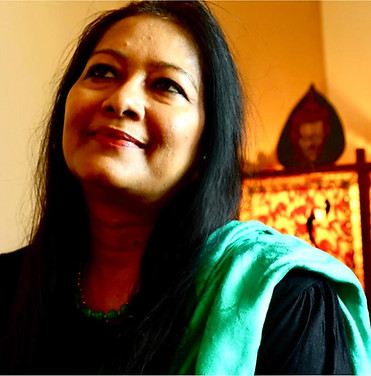
Author of Words Not Spoken(Brown Critique/Sampark) and The Longest Pleasure (Finishing Line Press, USA), Vinita Agrawal is an award winning poet and writer. She won the Gayatri GaMarsh Memorial Award for literary excellence, New Jersey 2015. Her poems have appeared in Asiancha, Constellations, The Fox Chase Review, Pea River Journal, Open Road Review, Stockholm Literary Review, Poetry Pacific and over a 100 other national and international journals. She was nominated for the Best of the Net Awards 2011, awarded first prize in the Wordweavers Contest 2014, commendation prize in the All India Poetry Competition 2014 and won the 2014 Hour of Writes Contest thrice. Her poems have found a place significant national anthologies like Suvarnarekha and Dance with the Peacocks in several international anthologies compiled in Australia. She was co judge for the Asian Cha Poetry Contest 2015. She has given readings at two SAARC events in Delhi and Agra. She also read her poetry at Hyderabad at an event organized by the U.S. Consulate to celebrate the Women Poets Of India, at Delhi for Delhi Poetree at the launch of Word Wine an an anthology of her poems and at Mumbai, Cappucino Readings, an eclectic platform showcasing poets from India and abroad. She can be reached at https://www.pw.org/content/vinita_agrawal and at www.vinitawords.com
About Rachna Singh
A doctorate in English literature and a former bureaucrat, Rachna Singh has authored Penny Panache (2016) Myriad Musings (2016) Financial Felicity (2017) & The Bitcoin Saga: A Mixed Montage (2019). Her book, Phoenix in Flames, is a book about eight ordinary women from different walks of life who become extraordinary on account of their fortitude & grit. She writes regularly for National Dailies and has also been reviewing books for the The Tribune for more than a decade. She runs a YouTube Channel, Kuch Tum Kaho Kuch Hum Kahein, which brings to the viewers poetry of established poets of Hindi & Urdu. She loves music and is learning to play the piano. Nurturing literature & art is her passion and to make that happen she has founded The Wise Owl, a literary & art magazine that provides a free platform for upcoming poets, writers & artists. Her latest book is Raghu Rai: Waiting for the Divine, a memoir of legendary photographer, Raghu Rai.

Talking Books
Click Hyperlink to read other interviews
