
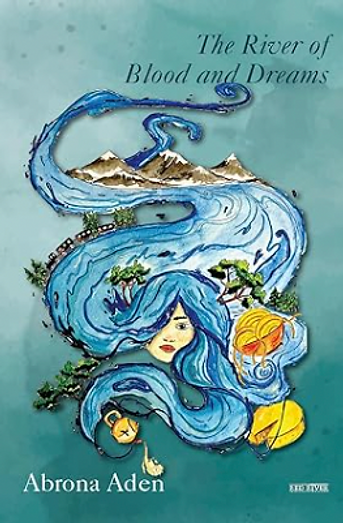
The River of Blood & Dreams
By Abrona Aden
Red River, 2026
The River as Anti-Archive: Currents of Memory in Abrona Aden’s The River of Blood and Dreams
By Aditi Dasgupta
In a nation that has regions and communities it thinks it understands because it has studied them, Abrona Aden’s The River of Blood and Dreams unsettles these habits. This poetry collection is a sustained interrogation on revisiting the primal question: who gets to produce knowledge about people, language and a landscape. Aden seems to be primarily mindful of not simply introducing the Lepcha culture to ‘outsiders’ but writes to examine narratives that have historically spoken over it.
For much of modern Indian literary discourse, the Northeast has occupied a paradoxical position. This region has been the epicentre of political debates and continues to be culturally and literarily marginalized within mainstream national narratives. Postcolonial thinking, by habit, have continued to treat Northeastern peoples as subjects of documentation rather than participants in intellectual production and the result, therefore, has been persistently unbalanced. This landscape has birthed stories, languages, cosmologies and political movements over the years, yet much of the Indian literary scene has encountered the region through stereotypes, tourism, insurgency headlines or anthropological descriptions. This makes Aden’s poetry collection sharper in its intent. Through these poems, Aden participates in a growing body of indigenous and Northeastern writing that contests what Spivak essentially identified as the problem of representation: who gets to speak and who is spoken for. Aden’s conscious return to museums, stereotypical gastronomy, language loss and translation form the historical conditions through which Lepcha identity has been mediated. Thus, Aden isn’t simply a cultural informant. She does not explain the Lepcha life for her audience. The opening poems establish this project with sophistication.
Looking for the Lepchas stages an encounter with institutional memory. Libraries, museums and archives appear as a currency for classification and not simply as a repository of lived experience.
I look for myself in the museum:
pieces, artefacts, stones, displays.
I feel preserved, taken care of, special even.
I could as well crawl in there and pose,
then, I grow cold, like the objects staring back at me.
I feel endangered.
In other words, calling this book as an archive would be naive. Beyond the simple act of preserving history, the poet asserts with clarity that being documented is not the same thing as being understood. This concern deepens in My Rong Tongue which is one of the strongest lyrical pieces in the collection. Aden’s attempt at preserving the lingua without turning it into a relic is noteworthy. Dumpling Country and Angels and Bagpipes are among the collection’s most formally agile works because they expose the mechanics of stereotypical cultural recognition. Recent postcolonial criticism has explored how minority identities are often rendered visible through consumable markers like food, costume, festivals and appearances. These poems interrogate that process but with some intelligent wit. What particularly struck me is how Angels and Bagpipes complicates simplistic notions of authenticity by tracing historical entanglements between Scotland and Kalimpong.
His bagpipes, they remind me of home,
my Himalayan town of Kalimpong.
I show him videos of girls in a school band on YouTube
playing bagpipes and wearing kilts.
He’s amazed at just how Scottish they look –
almost eighty percent, he says.
He plays a tune for me.
I’m astonished it’s the same tune as my school anthem
In Kalimpong.
The group of familial poems (as I would like to call it) deserve attention for the way they resist conventional maternal symbolism. Mother’s Poems, Eating at My Mother’s Table and I Come from Women are less interested in motherhood as a sentiment and focus more on motherhood as knowledge transmission. The mother’s table as an exhibit that carries history outside official institutions asserts that intellectual authority is perhaps more significant than any systemic library. This personal peak slowly transitions to environmental poems which is the book’s most significant intervention. Forest Thoughts, When a Lepcha Dies and especially The River Below the Teesta denounce the typical nature-culture divide by re-introducing rivers, forests and mountains as symbols of cultural agency, and the title poem The River of Blood and Dreams demonstrates this most powerfully. In these poems, the river is the site where personal memory, socio-political struggle and environmental vulnerability converge.
What does a river dream of?
If only we knew, even of the fragments of her dreams
that now lend their light to another
home, state, country…
As a reader, I could feel the tension of communities whose identities are rooted in specific landscapes and related displacement. Several later poems, including In Translation, After Translation, and Thoughts of Women Not in a Poem, carry another weighted inquiry towards the politics of the language. Aden’s poetic craft reveal what translation cannot carry. The residues, fractures and excesses that remain outside linguistic transfer are laid bare, and in doing so, she challenges the assumption that cultural accessibility is always desirable.
It is also very interesting to note how the poems avoid traditional activism. This strongly reminded me of Homi Bhabha’s notion of hybridity opening up the formal and thematic tensions. Bhabha’s “in-between” space is where identity is neither fixed in tradition nor fully absorbed into modern national narratives. This exposes its fractures and costs. The poet’s relationship to language, culture and naming reveals the “unhomely” where the intimate and the historical collapse into one another and where belonging itself becomes unstable. This is why Abrona Aden’s craft shines brightly: she not only informs her readers about Lepcha experience but invites every set of eyes to reconsider how history itself is constructed when push comes to shove. What ultimately distinguishes The River of Blood and Dreams is its challenge to the dominant stereotypical narrative of Indian poetry. By relocating the imaginative centre of the Eastern Himalayas from the typical metropolitan experience, Aden resurrects a community that is the object of study rather than a producer of knowledge. The poet, indeed, sends out an intense far cry from Africa. In that sense, the collection belongs to an important contemporary movement: the one that divests typical ethnographic legibility and claims a legitimate intellectual sovereignty.
The river running through these poems is thus, the counter current of narratives, memory, land and history waiting to be heard differently.
About the Author
Abrona Lee Pandi Aden

Abrona Lee Pandi Aden is an Assistant Professor at the Department of English, Sikkim University, India. She belongs to the Lepcha community indigenous to Sikkim and Darjeeling hills. Her short stories and poems have appeared in Muse India, Mekong Review, Sapiens Anthropology Magazine, The Bangalore Review, among others. She is a recipient of the ICM Global South Translation Fellowship awarded by the Institute of Comparative Modernities, Cornell University, in 2022. She has been the Charles Wallace India Trust Creative Writing Fellow at the University of Kent, Canterbury, UK, during their Spring Term, 2024. She enjoys living in Kalimpong and Gangtok, surrounded by her family, friends, cousins, relatives, her people. Every time she sees the mighty Kongchen Konglo, she knows she is home.

Aditi Dasgupta is an ordinary feminist with an extraordinary hunger for stories. A researcher at heart, her MPhil in English literature delved into postcolonial traumas in Indian literatures. She honed her craft through a Diploma in Translation & Creative Writing at Ahmedabad University, a residency at Yale, and the Institute for World Literatures at Harvard. Her book, Silencing of the Sirens, has drawn critical acclaim, and her words echo in Borderless Journal and The Writer’s Hour Magazine, weaving history, pain, and resilience into narratives that refuse to be silenced.