

Pierre Auguste Renoir
National Gallery of Modern Art London

In The Presence of Art
I walked into the National Gallery of Modern Art in London carrying the ordinary weight of the day, and walked out lighter. In its post-Impressionist wing, I found myself arrested by the quiet brilliance of Renoir.
The Umbrellas, The Skiff, and At the Theatre bear witness to his Impressionist eye, even as they trace his gradual drift towards classicism—nowhere more eloquent than in The Umbrellas itself. To stand before these works from the 1870s and 1880s is to feel time momentarily dissolve, as if the centuries politely step aside to let colour and light speak.
In The Skiff, Renoir’s audacity reveals itself in a single, luminous gesture: a bright orange boat set against dark, rippling blue water. The complementary colours vibrate in conversation, each intensifying the other, creating a visual rhythm that feels at once spontaneous and supremely assured. It is astonishing to encounter such modern vitality in paintings born more than a century ago—canvases that still pulse with life, confidence, and an unshakeable belief in the beauty of the seen world.
Works of some Artists (Part 2)
Pierre Auguste Renoir
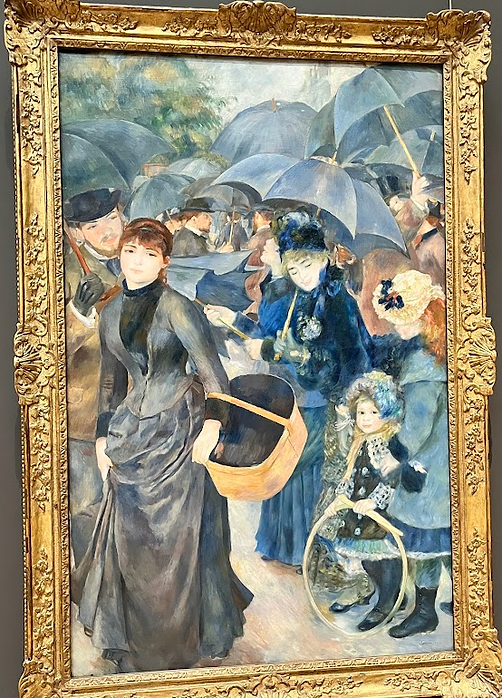
The Umbrellas
National Gallery of Modern Art, London
This painting places us in a busy Parisian street close to six principal figures who fill the foreground. A milling crowd behind them almost completely blocks out the boulevard beyond. The top quarter of the picture is mostly filled by a canopy of at least a dozen umbrellas. Painted in two stages, with a gap of around four years between each stage, it shows the change in Renoir’s art during the 1880s, when he was beginning to move away from Impressionism and looking instead to classical art. The group on the right, which includes a mother and her two daughters and the woman in profile in the centre, is painted in a characteristically Impressionist manner with delicate feathery touches of rich luminous tones. On the left of the composition, completed during the second stage, Renoir adopted a more linear style. The figures here, including the full-length young woman and the man standing behind her, have clearly defined outlines, precisely drawn features and a greater sense of three-dimensional form.

The Skiff ( La Yole)
National Gallery of Modern Art, London
This sunlit scene on the river Seine is typical of the imagery that has come to characterise Impressionism, and Renoir includes several familiar Impressionist motifs such as fashionably dressed women, a rowing boat, a sail boat, and a steam train crossing a bridge. The exact location has not been identified, but we are probably looking at the river near Chatou, some ten miles west of central Paris, which was a popular spot for recreational boating. If Renoir’s choice of subject is characteristically Impressionist, this is also true of his painting technique. He creates an effect of summer heat and light by using bright unmixed paint directly from the tube and by avoiding black or earth tones. In placing the bright orange boat against the dark blue water, Renoir has deliberately used complementary colours, which become more intense when seen alongside each other.

At the Theatre (La Première Sortie)
National Gallery of Modern Art, London
We seem to be sitting in a box at the theatre with two young women, though we can’t be sure what is going on. We can’t see the stage and one of the women is looking away from us, the back of her bonnet hiding most of the other’s face. This sense of mystery is enhanced by the nearer woman’s pose, leaning forward slightly as though something is absorbing her attention. It may not be the stage performance that has captured her eye: in nineteenth-century Paris, attending the theatre was as much about social status as seeing the show. We get a strong sense of an atmosphere of people-watching in this picture. Among the audience in the background, a man in the lower tier and a woman above him stand out. They seem to have their eyes turned, either on us, the viewer, or on the young woman in the box.
No 24 (brown, Black & Blue)
Artist: Mark Rothko
Three forms, softened & enlivened by their flickering, brushy edges, appear to hover over a deep cadmium-red ground. The hues act in concert with the weight of the forms, the application of the paint and the size of the canvas to suggest a hazy, enveloping environment. This painting shows how he continued to explore the seemingly simple three-part composition and push it to increasingly dramatic & evocative ends.
