
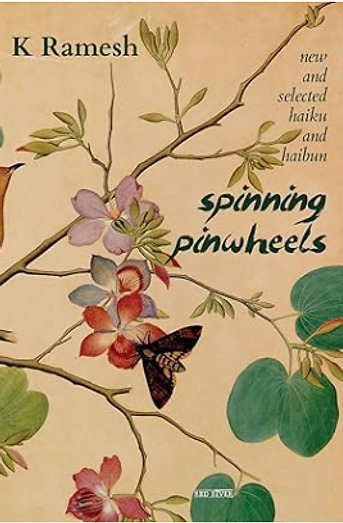
Spinning Pinwheels: New & Selected Haiku & Haibun
By K Ramesh
Red River (2025)
Silence, Stillness and Rhythm. Am I watching a film?
Lakshmi Iyer reviews Spinning Pinwheels: New & Selected Haiku & Haibun by K Ramesh
John Keats said, "The poetry of earth is never dead”. So true!
K Ramesh, a seasoned haijin, has mastered the art of tendering the macrocosm into microcosm; transcending the cycle of time and rebirth. Every poem has a story to tell and every story breathes slides of a typical Indian landscape, from village streets to school, through lanes and mountains and hills. The reader instinctively responds to the mood, emotions and perspectives wrapped up in a few chosen words.
vendor on the beach —
from hand to hand
a spinning pinwheel
Isn't it true that our lives are but a spinning pinwheel, constantly re-energising and rejuvenating our inner chakras.
Keen observations, subtle lingering moments and the silences hidden between the pause and the action is what has stayed with me. Ramesh's eye lens has captured images beyond one's imagination, questioning one's ability to have thought of that moment; ‘oh! How did I miss that!!’
As one begins to settle down with
village asleep . . .
a crescent moon
over Shiva's temple
thoughts reach out to
morning sun . . .
ducks drinking
at the village pump
And still as one ponders; K Ramesh's camera lens sets the stage with heron, sunbird, egrets, parakeets, flamingos, moth, cicada, fireflies, cormorants, blackbuck and even crabs and turtles! He has a special mechanism of bringing oneness in even the minute forms of living.
The mapping of seasons with visualising the
dewdrops on a leaf
the earth
holding oceans
summer morning . . .
a garden lizard drinks
the dewdrop on a leaf
with more such,
afternoon breeze —
sound of the loom
from the weaver's house
dawn . . .
the neighbour's newborn
stops crying
It makes me wonder how Ramesh has worded so wordlessly every second of his experience to call it a Haiku moment!
K Ramesh's love for photography is the icing on the cake which navigates his inner voice to be the keen observer and transports us to reflect upon the pause.
The catchy scenes of
misty railway station . . .
a man in shawl reading
the newspaper
waiting for the storks
to cross the red sun
camera and i
and much more cultivate my approach and responsibility to understand and write Haiku not just for the sake of it, but to connect with the natural world.
Who am I to judge the structure and aesthetics of the poems? ‘soap bubbles’ ‘pebble to pebble’ and ‘a small tree of tender leaves’ — soaks in gentle and innocent haiku and the journey continues!
On the Road, a Haibun amidst others speaks of the poet's sensitivity and how grounded he is as he articulates his emotions.
The bold cover painting pulls us through; so too the introduction, foreword and afterword! A million thanks to K Ramesh for crafting a splendid book.
About the Author
K. Ramesh writes haiku and other Japanese forms of poetry. His poems have appeared in magazines and anthologies published in India and abroad . He is the author of four volumes of haku. The latest one is titled Spinning Pinwheels published by Red River. He teaches physics at Pathashaala(pcfl-kfi), a J Krishnamurti School located near Chengalpet.


Lakshmi Iyer from Trivandrum is the co-editor of ‘amber i pause’. Her article, "Prakriti - the pulsating voice of the Gunas," can be read in One Thread: Zoka in Contemporary Haiku chosen as Best Anthology in the HSA Merit Book Awards, 2025. She is the winner of The Tejasvat Award in haikuKATHA, November 2025 for her five outstanding tanka in this issue.